|
Volume 01 · № 03 · July 16, 2026 |
|
The
Throughline
|
from CIOPages
|
An Independent Briefing for Technology Leaders |
This issue: knowing when to stop. The hardest number in any migration isn't the budget — it's the one already spent. We look at the sunk-cost trap and how to build the off-ramp before you need it. |
The Big Read · the feature
The Sunk Cost Trap in Multi-Year Platform Migrations
Every multi-year migration reaches the point where the smart move is to stop — and the spent millions scream not to. Here's why sunk cost is a reputational trap, not a financial one, and how to build the off-ramp before you need it.
Read the full article on ciopages.com →
|
The Corner Office · a short take
Reputational Sunk Cost
The textbook sunk cost is money already spent. The one that actually traps organisations is reputational. By the time a project should be killed, someone senior has staked their credibility on it — defended it in the steering committee, sold it to the board, hired a team around it. Stopping doesn't just write off the spend. It writes off them. So they keep going. Good money chases bad, not because anyone believes the numbers, but because the alternative is a public admission. The organisation ends up funding failure to protect an ego, and everyone in the room knows it. The fix isn't more financial discipline; it's cultural. Make it safe — even admired — to call a halt. Celebrate the executive who stops the doomed programme as loudly as the one who ships. Until killing your own project is a career-positive act, your smartest people will quietly keep the zombies alive to save face. |
Decoded · in plain terms
Escalation of Commitment
Escalation of commitment is the tendency to pour more resources into a failing course of action precisely because of what's already been spent. It's the sunk-cost fallacy with a budget line and a sponsor's reputation attached. In practice it sounds like “we're too far in to stop.” But money and time already spent are gone whatever you decide next; the only honest question is whether the remaining cost is worth the remaining benefit. Escalation is what happens when that question gets quietly replaced by “we can't waste what we've put in” — which is how organisations fund doomed projects to completion. |
CIO Intelligence Suite · Software
Stop running build-vs-buy in a spreadsheet.
The CIO Intelligence Suite turns the calls you face — build vs. buy, cloud cost, modernization sequencing — into structured, defensible models you can take straight to the board.
Explore the apps →
|
The Toolbox · Free download
Sunk-Cost Circuit-Breaker
Set the stop conditions before a migration starts — overrun thresholds, value-erosion triggers, a named decision-owner, and a review cadence — so “we're too far in” never wins the argument.
Get the free download →
|
|
Comic Sans
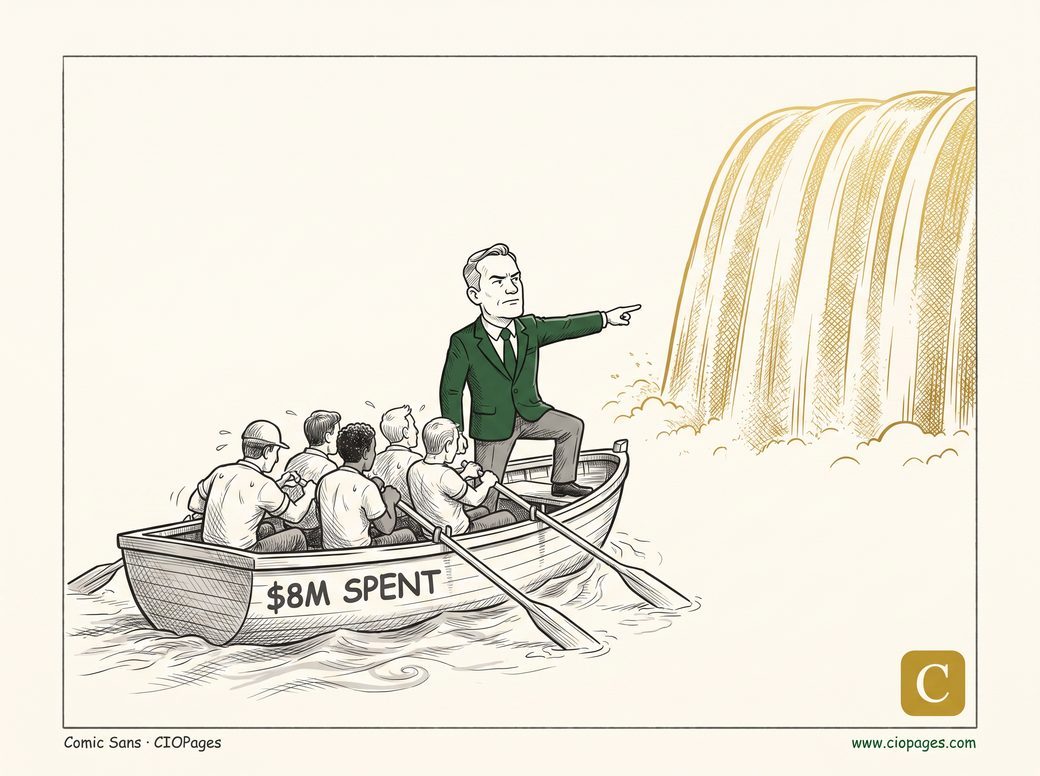
We're too invested to turn back now. |
Edge Case
A migration has consumed $8M of a planned $10M. Finishing needs the last $2M and will deliver $2.5M of value. A clean alternative delivers the same $2.5M for $1.2M. Ignoring everything spent, what should you do? |
Verse Control
The project's been “eighty percent”
Since back when the kickoff was meant.
That last fifth's a ghost,
Forever almost—
It's where all the budget is spent.
|
The Store · Digital products
Asset Management Business Architecture Toolkit
A ready-to-use business architecture toolkit for Asset Management — 410 capabilities, 60 value streams, and a complete data model. Skip months of discovery.
View in the store →
|
Edge Case — the answer
Compare forward costs only. Finishing: spend $2M for $2.5M (net +$0.5M). Alternative: spend $1.2M for $2.5M (net +$1.3M). Take the alternative — the $8M is gone either way and must not enter the decision. |
Share this issue
LinkedIn
X
Email |
Independent. No sponsorships. No affiliate revenue.
© 2026 CIOPages — A Capstera property. All rights reserved.
You are receiving The Throughline because you subscribed at ciopages.com.
Unsubscribe ·
Privacy · ciopages.com
|