|
Volume 01 · № 05 · August 16, 2026 |
|
The
Throughline
|
from CIOPages
|
An Independent Briefing for Technology Leaders |
This issue: the quiet percentage that decides everything. WACC, hurdle, or risk-adjusted — and the risk-appetite argument hiding underneath the rate. |
The Big Read · the feature
The Discount Rate Debate: What Cost of Capital for Cloud Commitments?
WACC, hurdle rate, or risk-adjusted? For a cloud commitment the choice of rate quietly decides the answer — and the room is usually arguing about risk appetite without saying so. Here's which rate fits which decision.
Read the full article on ciopages.com →
|
The Corner Office · a short take
The Argument You're Actually Having
When a room spends an hour arguing about whether to use 8% or 12% as the discount rate, they are almost never arguing about the cost of capital. They're arguing about risk appetite — how much they trust this team, this vendor, this bet — and routing the whole disagreement through a percentage because that feels objective. It's a proxy war, and proxy wars are inefficient. The real disagreement stays unspoken while everyone fights about a number that's standing in for it. You can spend more deciding the rate than the decision could ever save. Name the actual argument. Ask: how risky do we really think this is, and why? Put the assumptions about volatility, reversibility, and trust on the table directly. The discount rate should follow that conversation, not substitute for it. A leader's job is to drag the implicit debate into the open — because once you're arguing about risk honestly, the rate usually sorts itself out. |
Decoded · in plain terms
Cost of Capital / Hurdle Rate
The cost of capital is the minimum return an investment must clear to be worth funding; used as a discount rate, it shrinks future cash flows back to today's value. A “hurdle rate” is the threshold version of the same idea — the bar a project has to beat. The catch is how much that single percentage decides. Set it too low and weak projects sail through; set it too high and good long-horizon bets — most platform and capability work — get killed for being slow to pay off. Arguments about the rate are usually arguments about risk appetite in disguise, and worth having out loud. |
CIO Intelligence Suite · Software
Stop running build-vs-buy in a spreadsheet.
The CIO Intelligence Suite turns the calls you face — build vs. buy, cloud cost, modernization sequencing — into structured, defensible models you can take straight to the board.
Explore the apps →
|
The Toolbox · Free download
Cloud Commitment Discount-Rate Cheat Sheet
When to use WACC vs a hurdle vs a risk-adjusted rate for cloud bets, with a worked NPV example showing how the rate flips the decision.
Get the free download →
|
|
Comic Sans
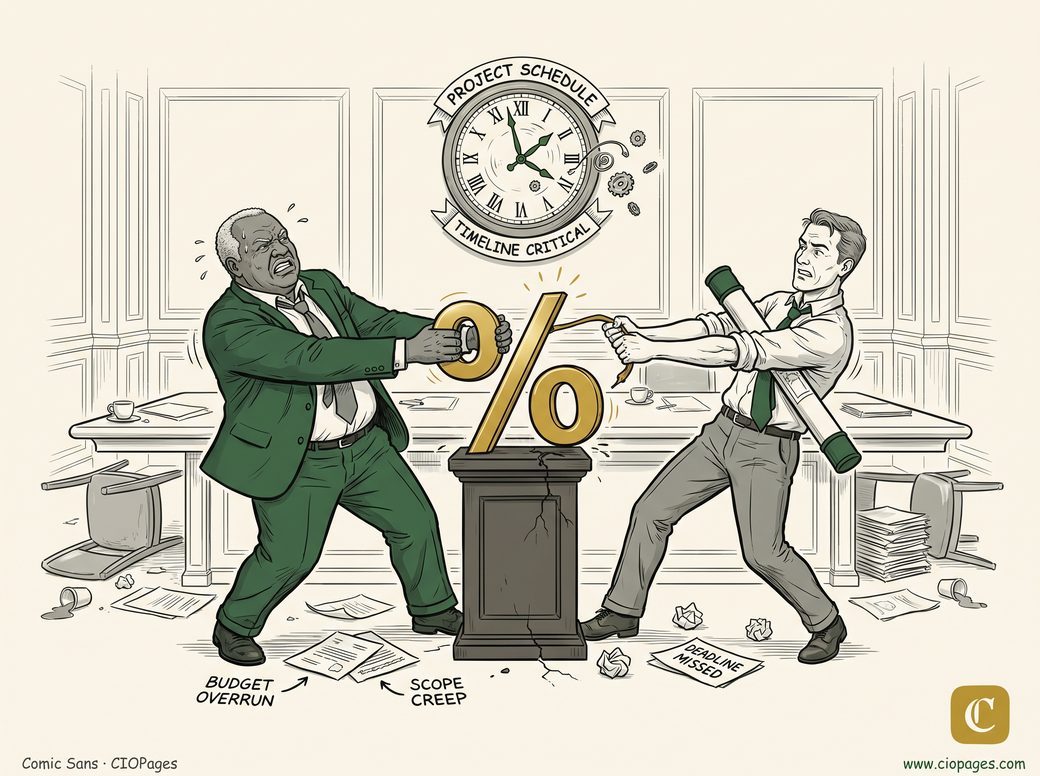
We've now spent more deciding the rate than it'll ever save. |
Edge Case
A cloud programme returns $5M/yr for 3 years for an upfront $11M. Roughly, does it clear the bar at an 8% hurdle rate? At 15%? |
Verse Control
A number, tucked deep and discreet,
Made a doomed little plan look complete.
Not merit, not need—
One cell, all agreed—
The rate chose who'd get the last seat.
|
The Store · Digital products
Capital Goods Sector Business Architecture Toolkit
A ready-to-use business architecture toolkit for Capital Goods Sector — 295 capabilities, 35 value streams, and a complete data model. Skip months of discovery.
View in the store →
|
Edge Case — the answer
PV of $5M/yr for 3 yrs ≈ $12.9M at 8% (NPV ≈ +$1.9M → approve) and ≈ $11.4M at 15% (NPV ≈ +$0.4M → barely). Same cash flows; the hurdle rate alone decides. Choosing the discount rate is choosing the answer. |
Share this issue
LinkedIn
X
Email |
Independent. No sponsorships. No affiliate revenue.
© 2026 CIOPages — A Capstera property. All rights reserved.
You are receiving The Throughline because you subscribed at ciopages.com.
Unsubscribe ·
Privacy · ciopages.com
|