|
Volume 01 · № 09 · October 16, 2026 |
|
The
Throughline
|
from CIOPages
|
An Independent Briefing for Technology Leaders |
This issue: the sprawl in the closet. Why your SaaS estate multiplied — and how showback fixes the symptom and the trust gap beneath it. |
The Big Read · the feature
FinOps Beyond Cloud: Applying Showback to SaaS Sprawl
Cloud has FinOps; your SaaS estate has a closet full of redundant subscriptions nobody owns. Here's how showback — not a spending crackdown — surfaces the duplicates and the trust problem underneath them.
Read the full article on ciopages.com →
|
The Corner Office · a short take
Sprawl Is a Symptom
When you open the closet and a hundred redundant SaaS subscriptions fall out, the instinct is to treat it as a procurement failure — sloppy spending to be clawed back. It's usually something more uncomfortable: a trust signal. Teams bought their own tools because the central path was too slow, too restrictive, or too absent. Sprawl is the workaround made visible. Every shadow subscription is a small vote of no confidence in IT's ability to deliver what someone needed, when they needed it. You can cancel them all and feel productive, but if you don't fix the underlying latency, the sprawl simply regrows under new names. So treat the symptom and the disease. Yes, consolidate and rationalise — but also ask why people went around you in the first place. Make the sanctioned path the fast path. An organisation that's easy to do the right thing in doesn't sprawl much. One that punishes patience with bureaucracy sprawls forever, no matter how many licences you cancel. |
Decoded · in plain terms
Showback vs Chargeback
Showback and chargeback are two ways to make teams feel what they consume. Showback reports what each team spent — visibility, no invoice. Chargeback actually bills it back to their budget. Showback usually changes behaviour with far less political blood, which makes it a strong first move against SaaS sprawl: simply showing teams their own spend, attributed and ranked, surfaces the duplicate tools and forgotten subscriptions. Chargeback bites harder but invites gaming and disputes. The choice is about how much friction your culture can absorb, not which is purer. |
CIO Intelligence Suite · Software
Stop running build-vs-buy in a spreadsheet.
The CIO Intelligence Suite turns the calls you face — build vs. buy, cloud cost, modernization sequencing — into structured, defensible models you can take straight to the board.
Explore the apps →
|
The Toolbox · Free download
SaaS Sprawl Showback Starter
Inventory every SaaS tool, roll spend up by team, and flag the duplicates — the first showback report that finds the redundant licences.
Get the free download →
|
|
Comic Sans
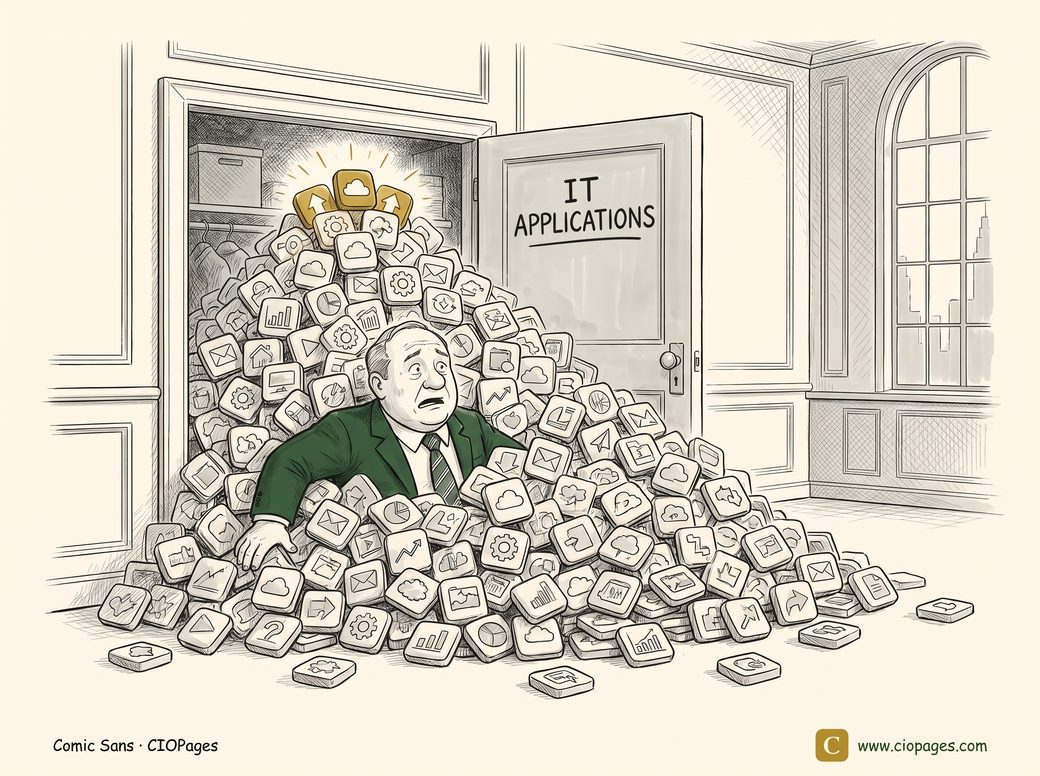
We have nine tools that do this. |
Edge Case
Five teams each pay for their own tool. Their needs are: A{contracts}, B{contracts, e-sign}, C{e-sign}, D{contracts, e-sign}, E{e-sign}. What's the minimum number of tools that still covers everyone? |
Verse Control
Each team bought its own little tool,
A login per head, as a rule.
Then finance went hunting,
And found, after counting,
Nine apps doing one job. How cool.
|
The Store · Digital products
Food Services and Restaurants Business Architecture Toolkit
A ready-to-use business architecture toolkit for Food Services and Restaurants — 350 capabilities, 52 value streams, and a complete data model. Skip months of discovery.
View in the store →
|
Edge Case — the answer
Two — one “contracts” tool (covers A, B, D) and one “e-sign” tool (covers B, C, D, E); or a single tool that does both, taking it to one. Five licences were never the requirement; two capabilities were. |
Share this issue
LinkedIn
X
Email |
Independent. No sponsorships. No affiliate revenue.
© 2026 CIOPages — A Capstera property. All rights reserved.
You are receiving The Throughline because you subscribed at ciopages.com.
Unsubscribe ·
Privacy · ciopages.com
|