 |
CIOPages |
|
Volume 01 · № 01 · June 16, 2026 |
|
The
Throughline
|
from CIOPages
|
An Independent Briefing for Technology Leaders |
Welcome to The Throughline — an independent briefing that takes one decision facing technology leaders and gives you the frame to make it, in about ten minutes, with no vendor agenda. We open on the most expensive blind spot in capital approvals: the options your business case never priced. |
The Big Read · the feature
The Real Options Nobody Prices in Technology Investments
Approve a $40M migration and the cash flows are only half of what you're buying — the rest is a portfolio of decisions your business case pretends you've already made. Here is how to price the options you actually hold.
Read the full article on ciopages.com →
|
The Corner Office · a short take
The Tyranny of the Confident Number
Committees don't avoid real options because the math is hard. They avoid them because keeping a door open looks like weakness in a room that rewards conviction. A leader who says “let's stage this and keep the right to walk away” sounds less impressive than one who declares a five-year NPV to two decimal places and stakes their name on it. So we perform certainty. We launder judgment through a spreadsheet and call the result rigor. The problem is that the confident number is usually the wrong one — it assumes a future you've already committed to and choices you haven't yet made. The braver act is to defend the option to change your mind. That takes more standing than producing a forecast, not less, because you're asking the organization to value being adaptable over looking decisive. Reward the leader who keeps doors open. They're the one actually managing risk. |
Decoded · in plain terms
Optionality
Optionality is the value held in keeping a future choice open rather than committing to it now. When you fund a cloud migration, you're buying two things: the cash flows in the model, and a portfolio of future decisions — to expand, pause, switch vendors, or walk away — each of which is worth real money. The catch is that a standard business case prices the first and ignores the second. It treats the investment as now-or-never and assumes you've already made every downstream choice. Naming the options you're actually buying (and the ones you're giving up) is usually worth more than any extra precision in the forecast. |
Decision apps · No charge
Have the analysis done before the meeting.
Enter your situation and each app returns a working document: an AI readiness score, a multi-year cost comparison with break-even, a drafted security questionnaire. Free with a CIOPages account.
See the apps →
|
|
Comic Sans
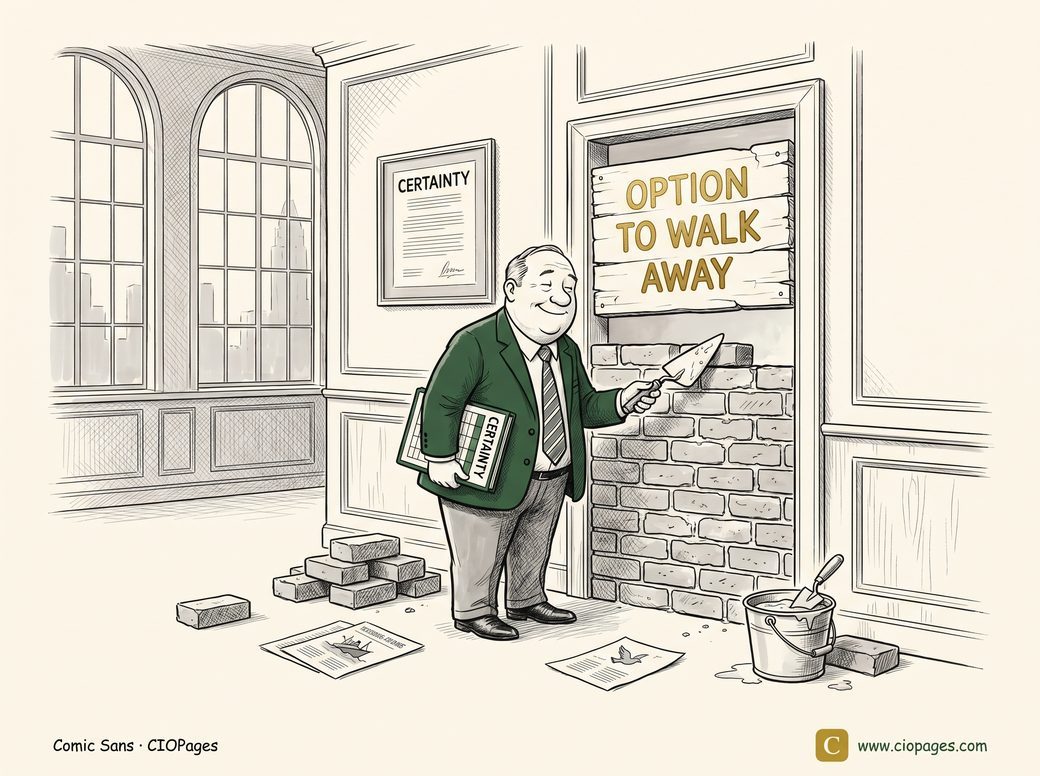
It models everything except the decisions we'll actually make. |
Edge Case
A migration can be approved as a big bang ($20M now; 50/50 it returns $30M or $6M) or staged: spend $8M now; if the first stage looks good (a 50% chance) spend $12M more to capture the same $30M upside — if it looks bad, stop and walk away. On expected value, which path wins, and why? |
Verse Control
“Why wait?” said the CIO, bold,
“I'll lock in at ten off, I'm sold.”
He saved on day one,
Then watched it undone—
The wait was worth more than the gold.
|
The Store · Digital products
Enterprise Business Architecture Toolkit: AI Transformation Blueprint
The whole enterprise with AI built in: 865 L3 capabilities, 20 value streams, a 398-entity data model, 79 agent specs, 119 use cases and 80 controls.
View in the store →
|
Edge Case — the answer
Big-bang EV = ½($30M) + ½($6M) − $20M = −$2M. Staged EV = −$8M + ½(−$12M + $30M) + ½($0) = −$8M + ½($18M) = +$1M. Same upside, but the option to abandon after stage one turns a losing bet into a winning one — the option was worth $3M. |
Share this issue
LinkedIn
X
Email |
|
|
