
How Paid Placements Work
Companies can pay to appear next to our Buyer Guides, and we keep that visibility separate from our independent analysis. Here is what we sell, and what we don't.
Always disclosed
We label paid placements wherever they appear. They are advertising. They are not an endorsement, a ranking or a recommendation from CIOPages.
Separated from editorial
Paid placements sit in their own block: a side rail and a footer band. They never appear inside the guide itself or in our independent vendor comparison.
No influence on our analysis
Buying a placement never changes how a company is covered in our vendor comparison, or whether it is covered at all. Our evaluations are not for sale, and paying companies get no special treatment.
What a placement looks like
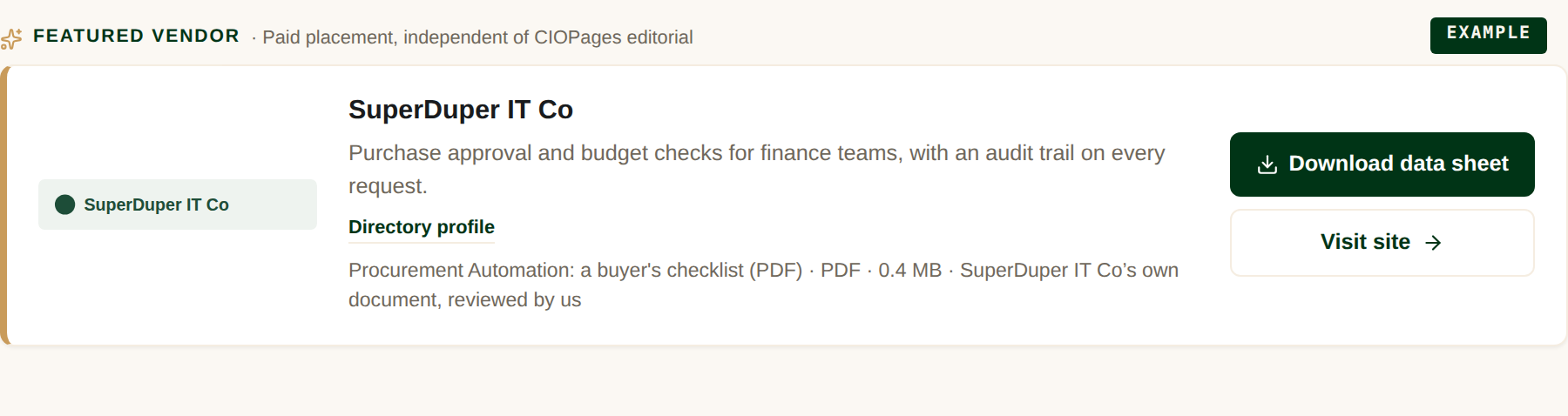
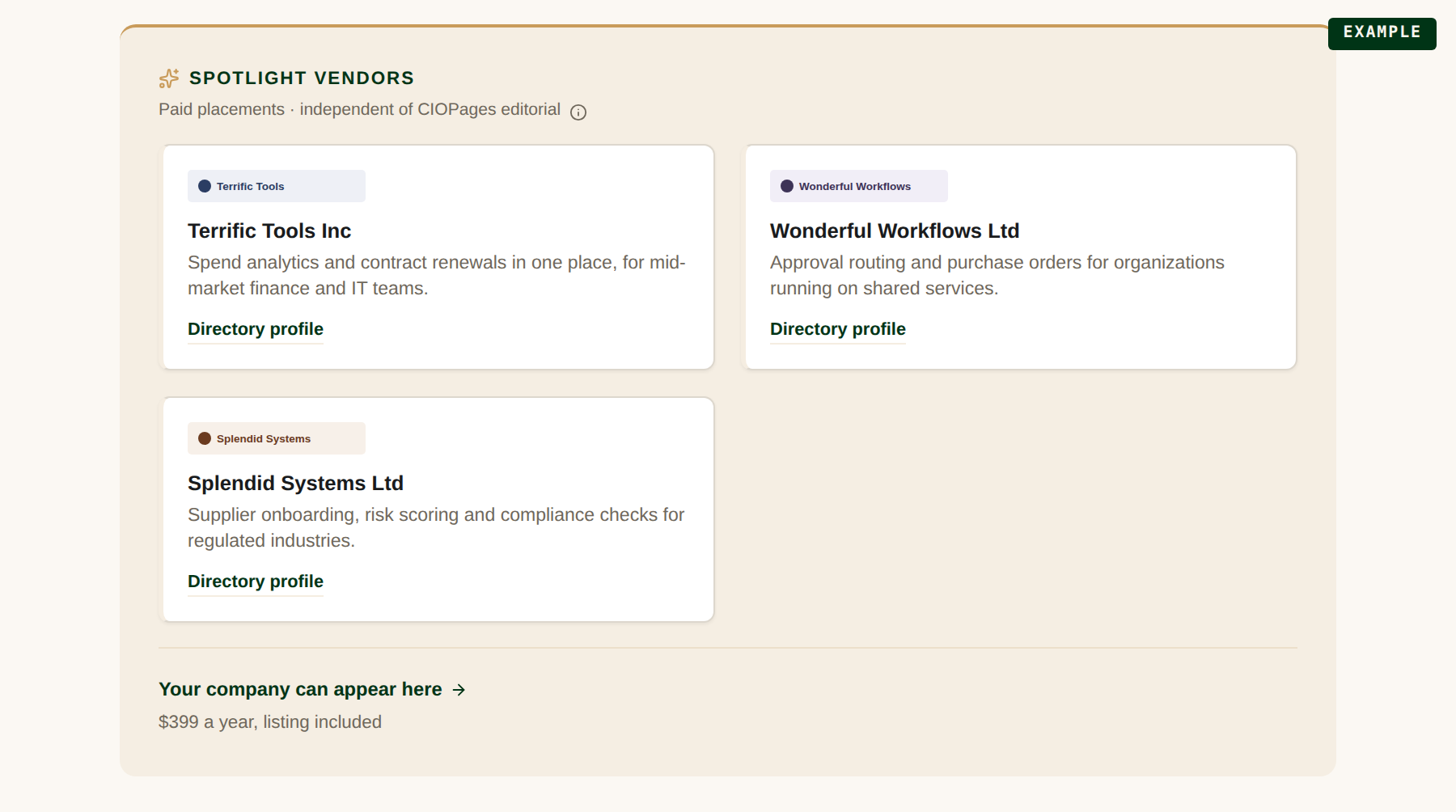
Taken from the real pages. The companies are invented — SuperDuper IT Co and the rest are examples, not customers.
What a placement is
On each Buyer Guide we sell a small, fixed number of paid placements, drawn from our vendor Directory. We cap each guide at 5companies. A placement is a card beside the guide, carrying the company's logo and a link to its own site, with a second link to its Directory listing. The only wording it shows is the same factual profile fields we review on every listing.
There is one exception. A claimed listing can offer its own documents and a short video, and the Featured Vendor band on a guide carries one of those documents. That material belongs to the vendor, and we label it as theirs everywhere it appears. Documents and video on a claimed listing are supplied and maintained by the vendor. We review them before publishing and will decline or withdraw anything that breaks our content standards, but we do not write them and we do not verify the claims they make. A document sits behind a form, which tells you before you fill it in that the vendor gets your details. A video just plays. None of it sits inside the analysis, and none of it changes what the guide says.
One company per guide can take the Featured Vendor band above the Spotlight cards. That is $699 per guide for the year, includes the claimed listing, and is bought on the same page as a Spotlight card. The same rules apply to it.
How vendors qualify
$399a year claims your Directory listing, which you then manage yourself, and includes a placement on one Buyer Guide your category is eligible for. That's the way in, and it's the number nearly everyone needs. More guides are $199 each. If no guide covers your category yet, you can claim the listing on its own for $199, and when we publish a guide you're eligible for, your first placement is $200— the difference between the two. There is nothing to buy first. We suggest the guides your category maps to, and you can search the rest, but a placement outside the mapping is held for review and an editor decides it.
Our editors review every submission before anything goes live, and nothing is charged until we approve it. At checkout we validate the card and hold it without charging. Then we confirm the company is who they say they are, that the category fits, and that the listing meets our content standards. We may edit the wording for accuracy before we approve. We charge the card and publish the listing only once we approve. If we decline, we cancel the payment and the buyer is never billed.
Corrections are always free. If anything in a listing is wrong, anyone can tell us and we will correct it, whether or not that company is a customer. What you pay for is managing the listing yourself and appearing on the guides.
Want a placement?
Claim your listing and choose your guides on one page, or read the full terms first.
For what we don't sell — links in editorial copy, sponsored articles, a place in the vendor analysis — see the Editorial Policy.