
Anthropic, PBC filed its registration statement for an initial public offering with the SEC on October 26, 2026 [1]. The prospectus is preliminary. It sets no offering price, and leaves several figures blank, including the total of its compute commitments [1].
Read as a customer, the filing says four things. Most of Anthropic's revenue is metered usage, not licenses. Its growth comes from existing customers spending more. Its costs arrive as compute bought 12 to 18 months ahead, which management says will make operating margins swing [1]. And customers and public shareholders have no vote that can change its pricing or roadmap.
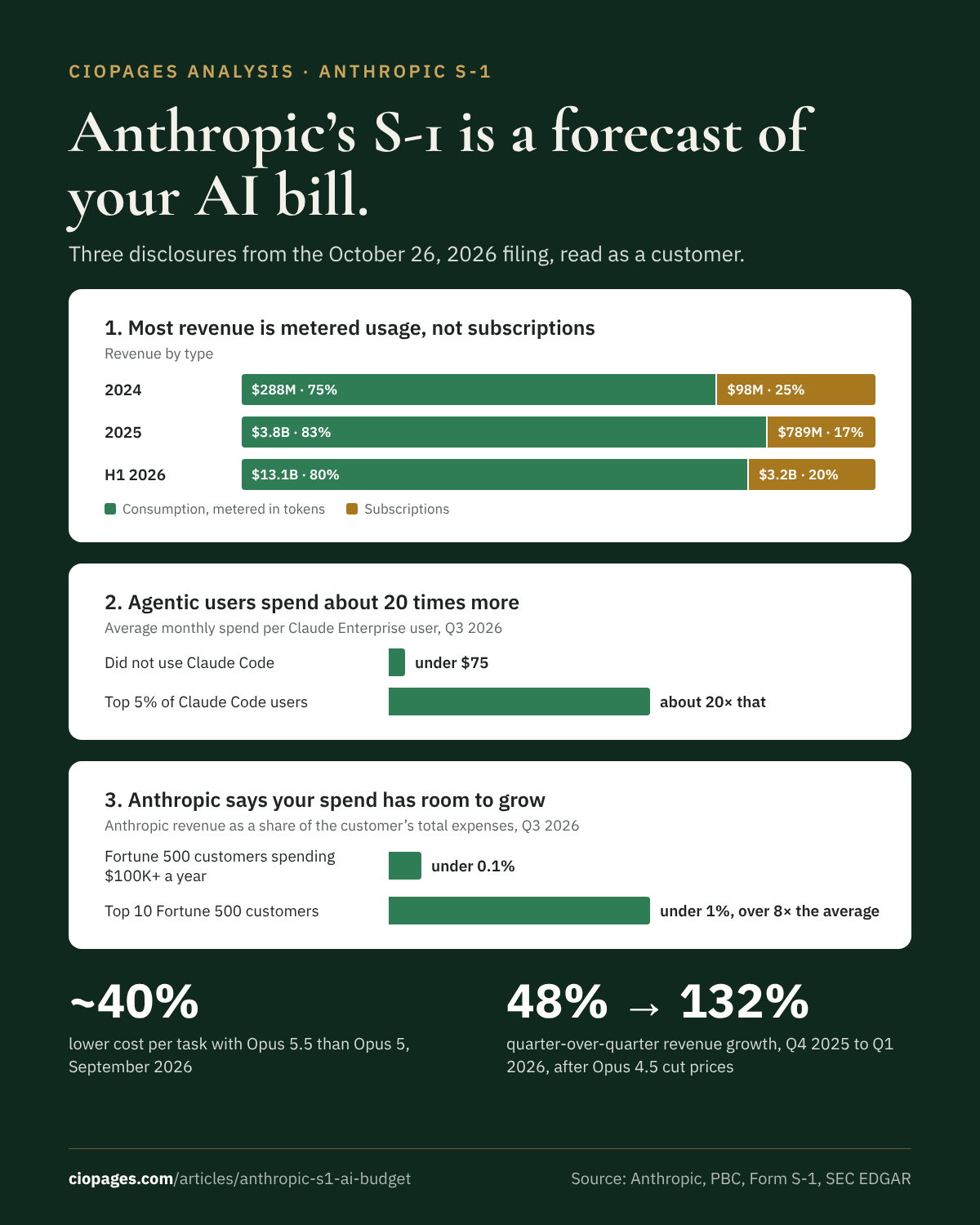 Claude Code, Anthropic revenue as a share of Fortune 500 customers' expenses, and cost per task against revenue growth. The figures are in the text below.">
Where the revenue comes from
Revenue was $41 million in 2023, $386 million in 2024 and $4.6 billion in 2025 [1]. In the six months to June 30, 2026, it was $16.3 billion, up from $1.2 billion a year earlier [1]. The filing states: "We do not expect our revenue will continue to grow at comparable rates, and we cannot assure you that it will continue to grow at all" [1].
Consumption-based revenue was $13.1 billion, or 80% of the total, in the first half of 2026 [1]. Subscriptions were $3.2 billion, or 20% [1]. The filing defines consumption as usage "metered in tokens and priced according to the model selected" [1].
That is how cloud infrastructure is billed. Most enterprises still budget AI the way they budget software: seats, annual licenses and a line in the application portfolio.
The 900% retention figure
Anthropic reports net revenue retention of approximately 900% as of September 30, 2026 [1]. The definition explains the number. It compares a customer's revenue in the latest quarter with that customer's revenue in the same quarter a year earlier. A "Qualified Customer" needs only $1 of revenue in the earlier quarter, and Claude Pro and Max subscribers are excluded [1].
If a team spent $100 in a pilot quarter and $10,000 a year later, it counts at 10,000%. The figure measures expansion from small starts. It says nothing about how long the expansion lasts. The filing says recent growth "may reflect early-stage adoption dynamics, the nascency of the AI market, and rapid initial customer expansion" [1].
No single customer was more than 10% of revenue in the nine months to September 30, 2026 [1]. About 79% of third-quarter revenue came from customers outside the top five, up from about 64% in the first quarter [1]. By that measure [1], the top five fell from about 36% of revenue to about 21%. Revenue from each of the five still reached a record in the third quarter [1].
Five disclosures for the technology budget
1. Anthropic expects large customers to spend several times more
More than 11,900 customers spent $100,000 or more in the 12 months to September 30, 2026, up from more than 950 a year earlier [1]. More than 1,900 spent $1 million or more, and about 250 spent $10 million or more [1]. The $100,000 group includes every Fortune 10 company, over 50% of the Fortune 500 and over 30% of the Global 2000 [1]. About 40 million customers each spent less than $100,000 [1].
For publicly traded Fortune 500 customers in the $100,000 group, Anthropic's revenue averaged less than 0.1% of their total expenses in the third quarter of 2026 [1]. For its top 10 Fortune 500 customers, it averaged less than 1%, over eight times the group average [1]. The filing calls the difference "the substantial runway we have to deepen adoption" [1].
Plan against the top 10, not the average. A budget set as a share of IT spend, or per seat, assumes the average. Decide which workflows get uncapped consumption, and cap the rest workflow by workflow.
2. Unit prices are falling and total spend is rising
Fable 5.1, released in September 2026, cut the cost of typical workloads by about 25% against Fable 5, and by up to 45% for complex coding and highly agentic tasks [1]. Opus 5.5, released the same month, cut cost per task by about 40% against Opus 5 [1]. Each cut combined a lower price with better efficiency, and the filing says margins held [1].
Opus 4.5 launched in November 2025 with a lower price and cost per task than Opus 4.1 [1]. Quarter-over-quarter revenue growth then went from 48% in the fourth quarter of 2025 to 132% in the first quarter of 2026 [1]. The filing attributes the change to lower prices, new capability, new products and wider adoption together [1].
Plan for lower unit prices and higher volume. A discount on this year's price list loses value each time a new model resets the list. Negotiate terms on the meter itself: price protection tied to model releases, and the right to move committed spend to newer models.
3. Agentic tools spend at a different scale from chat
In the third quarter of 2026, Claude Enterprise users who did not use Claude Code spent less than $75 a month on average [1]. The top 5% of Claude Enterprise users who used Claude Code spent about 20 times that [1].
An agent reads context, calls tools, checks results, retries and starts sub-agents. Each step consumes tokens, and the cost is hard to tie to one person. Chargeback by seat and monthly accrual will understate agentic spend. Tag usage by agent, workflow and cost center, and alert on runs that loop. Stop measuring tokens, start measuring outcomes covers the unit to report.
Spend is also seasonal. Total customer spend fell about 20% in the two weeks to January 2, 2026, against the two weeks before, which the filing ties to holiday code freezes [1]. A forecast built on a monthly average misses both the dip and the rebound.
4. Model access depends on who you are
Anthropic sells its most capable model class in two configurations [1]. Fable is generally available. Its safeguards "block or limit performance on certain sensitive topics, including by routing requests to a less capable Claude model" [1]. Mythos runs with safeguards for vetted organizations and individuals doing cybersecurity and life sciences work, through trusted-access programs including the Cyber Verification Program [1].
Enterprise Frontier Safeguards, announced in September 2026, stores safety-monitoring data in the customer's own cloud account, under the customer's encryption keys [1]. Misuse alerts go to the customer's security team, and "No review by Anthropic employees is required" [1]. Until the rollout is complete, eligible customers get zero data retention on Fable 5 and Fable 5.1, except where law or misuse requires otherwise [1]. Claude for Government runs in a FedRAMP High authorized environment [1].
- Choosing a model is a governance decision. Which models you can use depends on how your organization is verified.
- Route requests by data classification and trust tier, not to one preferred model.
- Ask how a request routed to a less capable model shows up in logs and API responses, and test for it in your evaluations.
- Put in-account monitoring and retention terms in the contract, not in a rollout schedule.
5. Anthropic is building the implementation layer
In October 2026 Anthropic launched the Claude Frontier Academy, backed by a $100 million commitment [1]. It aims to train 10,000 engineers by the end of 2027, starting with consulting firms and enterprises [1]. The filing names the constraint it addresses: "the shortage of engineers who can take AI from an initial use case into production" [1].
Anthropic also has Applied AI teams that include forward-deployed engineers [1]. It sells through systems integrators including Accenture, Deloitte, KPMG and PwC, and it launched Ode with Anthropic, a services company formed with private equity firms to serve mid-sized companies [1].
Engineers trained by the vendor add deployment capacity. They are trained to Anthropic's standard, on Anthropic's platform. Decide which parts you will own: the agent harness, the evaluation sets, the skills library and the usage telemetry.
Risks the filing states
Operating margins will swing. Most compute is bought under multi-year commitments 12 to 18 months before it is available [1]. When demand exceeds it, Anthropic buys short-term compute at a higher cost per unit [1]. Expense for new compute is recognized before the revenue it supports, so operating margins will fluctuate "at times meaningfully, even if the underlying economics of the business continue to improve" [1].
The commitments run to 2045 and the totals are blank. Substantially all of the purchase commitments and leases are for compute and infrastructure [1]. Part falls due before December 31, 2030, and substantially all of the rest between 2031 and 2045 [1]. The preliminary filing leaves every amount blank [1].
Power and partners. Some planned data centers rely on on-site natural gas generation, which is exposed to fuel prices and pipeline capacity [1]. Some cloud providers Anthropic relies on for compute are also investors in it, customers of it and competitors to it [1]. The filing says this could affect its "access to compute, its cost, or the prioritization of our workloads" [1]. Treat model supply as a resilience risk, alongside cloud regions, with a tested fallback for each critical workflow.
Cost of revenue is falling against revenue. Cost of revenue was $752 million in 2024, $2,773 million in 2025 and $2,380 million in the first half of 2026 [1]. Against revenue, that is about 195%, 60% and 15% [1]. These ratios are our arithmetic. Cost of revenue covers compute for customer-serving workloads; compute for model development sits in research and development [1].
Switching costs sit in the harness. Anthropic donated the Model Context Protocol to the Linux Foundation's Agentic AI Foundation in December 2025 [1]. The Agent SDK runs on the customer's own compute [1]. Claude Managed Agents runs on Anthropic's compute: Anthropic hosts the sandboxes, stores the credentials, maintains the memory and runs the agent loop [1]. "When a new model becomes available, customers do not need to rebuild their agent loop" [1].
A hosted harness, its skills and its telemetry are harder to move than a model. Choose hosted or self-run per workload. The filing names open-weight models as competitors for "enterprise workloads that prioritize cost efficiency over intelligence" [1]. That competition is your pricing leverage.
What customers cannot change
Anthropic is a public benefit corporation [1]. Its Long-Term Benefit Trust holds Class T stock and elects directors who make up a majority of the board [1]. A single Class F share, held by an LLC of its seven co-founders, carries 50.1% of the voting power on other matters [1]. Class N stock, held mainly by strategic partners including Amazon and Google, has no voting rights [1]. Anthropic will be a "controlled company" under Nasdaq rules [1].
No proxy campaign or customer group can change Anthropic's pricing, safety gating or roadmap. A customer's leverage is commercial and architectural, and it is greatest before signature.
A twelve-month plan
| When | Action | Evidence it happened |
|---|---|---|
| 0 to 30 days | Tag every token and agent session to a cost center, workflow and business owner. Report cost per completed task. Alert on variance and looping runs. | A consumption dashboard with one owner and a weekly forecast-versus-actual review |
| 30 to 60 days | Rewrite the contract: committed spend with consumption caps, price protection on model releases, service levels per capability tier, retention and in-account monitoring terms, audit rights, exit portability. | A signed AI addendum and a negotiation playbook |
| 60 to 120 days | Stop funding workflows with no measured cost per task and no evaluation set. Fund those where unit cost falls and volume rises. | Funded and defunded lists, signed by business owners |
| 90 to 180 days | Run agents as a platform: agent identity, short-lived scoped credentials, sandboxes, action logs, human approval for irreversible actions, evaluations in CI, rollback. | An agent reference architecture and policy as code |
| 6 to 12 months | Put a model gateway in front of every call, routing by data classification, cost and capability tier. Run two providers in production for critical workflows. | A routing policy and a two-provider proof of concept on one tier-1 workflow |
| Every quarter | Report three numbers to the board: cost per completed task by domain, share of workflows with evaluation coverage and a human gate, and share of AI spend with the main vendor. | A one-page board exhibit |
What would change this reading
- Retention falls or is redefined. Retention of approximately 900% [1] will fall as customer bases grow. Watch whether the definition changes when it does.
- Margins compress. If capacity costs outrun revenue, expect price increases or tighter capability tiers, not discounts.
- The blank commitments are filled in. Their size shows how much revenue Anthropic must earn through 2045.
- Prices fall faster than usage grows. If cost per task keeps falling and revenue growth slows, AI budgets stop compounding.
- Open-weight models catch up on routine work. If an open model handles most of your workload, your negotiating position improves.
Enterprises that do well in this cycle will know what a completed unit of work costs, in a number their CFO accepts. They will also have capped consumption, a portable architecture and two working suppliers when the next price list arrives.
References
[1] Anthropic, PBC. Form S-1 Registration Statement, preliminary prospectus, subject to completion. Filed with the SEC October 26, 2026. https://www.sec.gov/Archives/edgar/data/2130357/000162828026067168/anthropicpbc-sx1.htm
[2] SEC EDGAR. Filing index for Anthropic, PBC, Form S-1, accession number 0001628280-26-067168. https://www.sec.gov/Archives/edgar/data/2130357/000162828026067168/0001628280-26-067168-index.htm
Independent. No sponsorships. Unsubscribe anytime.