
The idea behind it
Egress is data leaving a cloud provider's network, whether to the internet, to another cloud or back to an organization's own data center. Major providers charge for it per gigabyte, while inbound transfer is usually not charged. The rate depends on the destination, the region and volume tiers. The charge grows with every integration, analytics feed and backup copy that pulls data out. It is also a large part of the cost of leaving a provider, because moving stored data out is billed at the same rates. The EU Data Act requires providers to stop charging switching fees, including egress for the switch itself, from 12 January 2027. Routine egress during normal use stays billable.
A dedicated interconnect, such as AWS Direct Connect, Azure ExpressRoute or Google Cloud Interconnect, is a private link between the provider and a data center or colocation site. It carries a fixed monthly port or circuit charge, and providers bill data sent over it at lower per-gigabyte rates than internet egress. Choosing one is a break-even calculation. At low volumes the fixed charge costs more than paying per gigabyte, and above some volume the link costs less. Growing data volume can carry a workload past that point within the term of a link contract.
What's inside
- Seven inputs: monthly data-out volume in TB, egress rate per GB, the dedicated link's fixed monthly cost, its per-GB transfer rate, its one-time setup cost, projection horizon (1 to 60 months) and annual data growth.
- Pay-as-you-go egress cost per month and per year, with and without growth, and over the projection horizon.
- The data volume at which a dedicated interconnect costs less than pay-as-you-go, with a yes/no verdict, the annual saving and the months to pay back the setup cost.
- A month-by-month projection over the horizon with cumulative cost for both options, including the setup cost, and the month the link pays back.
- A Guide tab, and a 2-page PDF guide: what egress cost is, how to use the calculator in four steps, a worked example at 50 TB a month, and five costs the calculator leaves out.
Format: PDF (2 pages) and Excel workbook.
A look inside
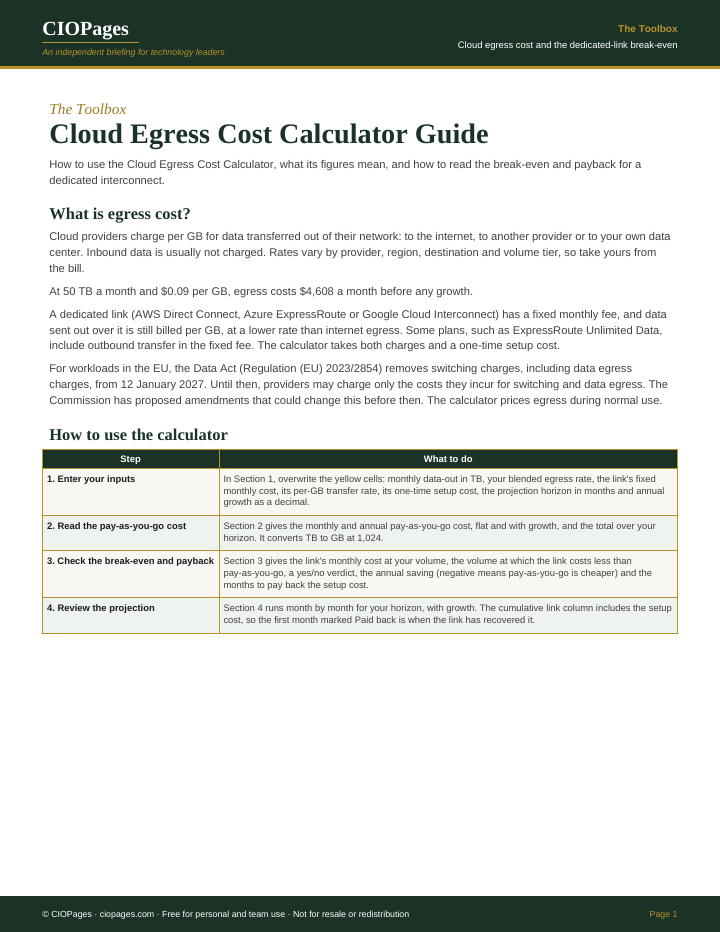
Page 1 of 2 of the PDF. Select an image to enlarge it.
Who uses it
- Cloud architects, to price a design's data flows before choosing a region or provider.
- FinOps practitioners, to explain a rising data-transfer line on the cloud bill and project where it is heading.
- Network and infrastructure leads, to test whether a dedicated interconnect pays back at current and projected volumes.
- CIOs planning a provider exit or repatriation, to put a first figure on moving the data out.
When to use it
- Data transfer becomes a visible line on the monthly cloud bill.
- A new analytics, backup or multi-cloud integration will send large volumes out of a provider.
- A network team proposes a Direct Connect, ExpressRoute or Interconnect circuit.
- A business case for leaving a provider or repatriating a workload needs an exit cost.
- A region or provider is being chosen for a data-heavy workload.
How to use it
Run it before committing to a provider or region, or when deciding whether a dedicated interconnect pays back.
- In Section 1 of the Egress Calculator sheet, overwrite the yellow input cells: monthly data-out in TB, your blended egress rate per GB from the cloud bill, the link's fixed monthly cost, its per-GB transfer rate (0 if the plan includes transfer), its one-time setup cost, the projection horizon in months and annual growth as a decimal (0.20 for 20%).
- Read Section 2 for the monthly and annual pay-as-you-go cost, flat and with growth, and the total over your horizon. The calculator converts TB to GB at 1,024.
- Read Section 3 for the link's monthly cost at your volume, the break-even volume, the yes/no verdict, the annual saving and the months to pay back the setup cost. A negative saving means pay-as-you-go is cheaper.
- Use the Monthly Saving and cumulative columns in Section 4 to see in which month, if any, the link has paid back its setup cost as volume grows.
- Check the five costs the PDF guide lists as left out (inter-region transfer, CDN egress, backups and snapshots, monthly allowances some providers give at no charge, and negotiated discount rates) and adjust the inputs for any that apply.
- Before a procurement decision, confirm the inputs against your actual cloud bill and get a firm quote from the interconnect provider.
You leave with: A monthly and annual egress cost at your volumes, the volume at which a dedicated link costs less, its payback on the setup cost, and a month-by-month view of both options.
Where it goes wrong
- Using the published internet egress rate when the bill shows a blended or negotiated rate.
- Comparing only the link's monthly fee with pay-as-you-go egress. Providers also bill data sent over an interconnect, at a lower per-GB rate, so enter that rate as well as the fee.
- Deciding on today's volume alone. The verdict compares current volume with the break-even, and the projection shows where growth takes it.
- Leaving backup, snapshot and replication traffic out of the volume estimate.
Get the calculator
It is free. Enter your work email and we send the download link.
Questions
What are cloud egress fees?
Egress fees are charges for data transferred out of a cloud provider's network, billed per gigabyte. They apply to data sent to the internet, to other clouds and to on-premises systems. Inbound transfer is usually not charged.
When is a dedicated interconnect cheaper than internet egress?
A dedicated interconnect is cheaper when a month's outbound data costs more at the pay-as-you-go rate than the link's monthly fee plus its own transfer charges. The calculator's break-even divides the link's fixed monthly cost by the difference between the egress rate and the link's per-GB rate. In the PDF's worked example, an $8,000 link at $0.02/GB against $0.09/GB egress breaks even at 111.6 TB a month.
How do you estimate the cost of moving data out of a cloud provider?
Multiply the data to be moved, in GB, by the egress rate for its destination, then add any transfer service or link costs. Check whether the provider waives egress for customers who are leaving. AWS, Google Cloud and Microsoft Azure announced such waivers in 2024, and the EU Data Act ends switching charges from 12 January 2027.