
The idea behind it
A real option is the right, but not the obligation, to change a business investment later: to delay it, expand it, shrink it, stop it or redirect it. The idea borrows from financial options. Stewart Myers coined the term "real options" in 1977, and Lenos Trigeorgis, Avinash Dixit and Robert Pindyck developed it into a method for valuing capital projects. A standard discounted cash flow (DCF) model treats a project as one fixed plan, committed on day one and run to the end. It gives no value to management's ability to change course as facts arrive.
That missing value is largest when uncertainty is high and decisions can be taken in steps, which describes most large technology programs. Formal real options valuation uses option-pricing models such as binomial trees or Black-Scholes, and few IT reviews have the data to run them. Naming the options is the practical first step. A review that can see a deferral point, a stage gate or an exit right can ask whether the project design keeps it and what losing it would cost. The six option types on the worksheet (defer, stage, expand, contract, abandon and switch) match the common types in the real options literature.
What's inside
- An "Investment Under Review" box: project name, decision owner, review date, the base-case NPV or IRR, and the business unit or program.
- An option inventory with six rows: defer, stage, expand, contract, abandon and switch.
- For each option, a prompt question, a space to name the specific option, a High/Medium/Low value flag, a Yes/No on preserving it and a notes column.
- A synthesis section with four questions on which options matter and what killing them would cost.
- Instructions for before, during and after the review meeting.
- The Excel version adds a filled-in sample for an ERP investment, including its synthesis answers.
Format: PDF (2 pages) and Excel workbook.
A look inside
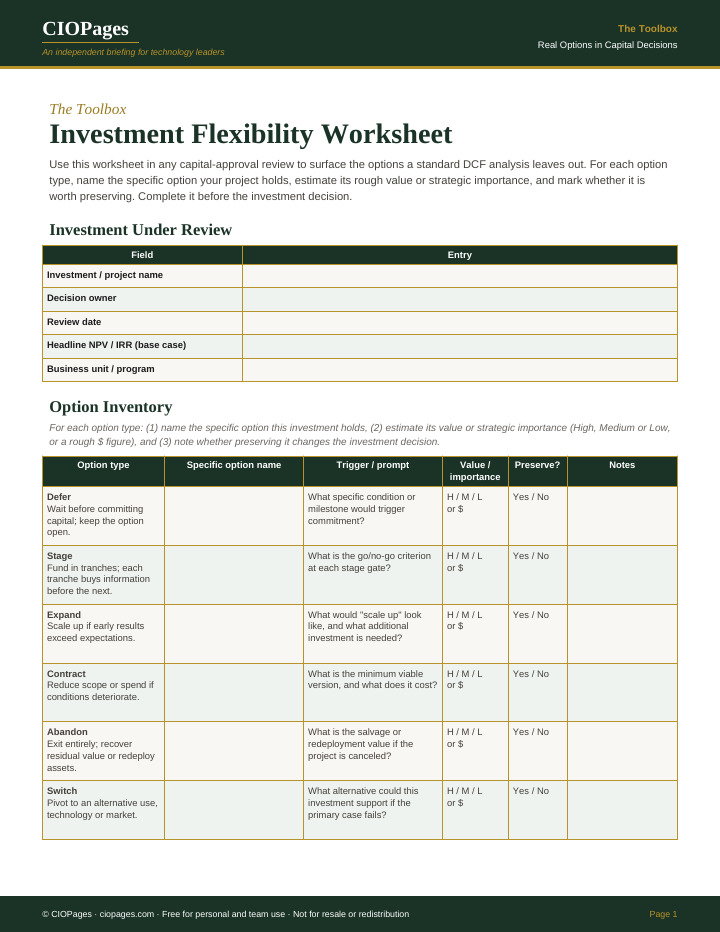
Page 1 of 2 of the PDF. Select an image to enlarge it.
Who uses it
- Investment sponsors, to show a capital committee the flexibility their project holds before the NPV is debated.
- CFOs and finance business partners, to test whether a claimed option can be exercised and whether it changes the decision.
- Enterprise and solution architects, to tie modular design choices to the options they keep open.
- Portfolio and PMO leads, to turn preserved options into stage gates and funding tranches in the program charter.
When to use it
- A business case goes to a capital-approval committee with a single NPV or IRR figure.
- An ERP, core platform or data center decision is framed as all-or-nothing.
- The NPV is marginal and the sponsor argues the project has strategic value the model misses.
- A vendor contract is still open on exit rights, fixed-price expansion terms or phased licensing.
- A program asks for its full budget up front although the later phases depend on how the first one goes.
How to use it
The sponsor fills in the options before a capital-approval review, and the review tests whether each one is real and whether it changes the decision.
- Fill in the Investment Under Review box: project name, decision owner, review date, the base-case NPV or IRR, and the business unit or program.
- Work down the Option Inventory. For each of the six option types, answer the trigger prompt and write the specific option this project holds in the Specific Option Name column. Leave a row blank if the project has no such option; the instructions treat a blank as information.
- Rate each option High, Medium or Low in the Value / Importance column, or enter a rough dollar figure, and mark Preserve? Yes or No.
- In the review meeting, take each option in turn and test two things: whether it can actually be exercised, and whether it changes the risk and return materially.
- Answer the four Synthesis questions, including whether preserving an option changes the go/no-go and what killing the most valuable one early would cost.
- Write the preserved options into the investment design as staged funding, modular architecture, contractual exit rights or explicit review gates.
You leave with: A named list of the options the investment holds, each rated and marked for keeping or not, and a record of the design choices the review agreed to keep them open.
Where it goes wrong
- Listing option types in the abstract. "We could expand later" is not an option until it names the trigger, the cost and who decides.
- Claiming options that cannot be exercised. An abandon option is worth little if the contract has no exit clause and the assets have no resale value.
- Using the options to rescue a project the DCF rejects. The worksheet's instructions set the aim as the investment structure that keeps the most value, not a reason to invest.
- Naming the options and then funding the project as a single commitment, so the options lapse when the contract is signed.
Get the worksheet
It is free. Enter your work email and we send the download link.
Questions
What is a real option in IT investment?
A real option is the right to change an IT investment later without being obliged to: defer it, stage it, expand or shrink it, abandon it or switch it to another use. Its value comes from uncertainty, because the option lets the organization act on information it does not have yet. A phased ERP rollout with a go/no-go gate after phase one holds a staging option.
Does real options analysis replace NPV?
No. Real options analysis supplements a DCF or NPV by adding the value of flexibility that the DCF assumes away. The base-case NPV stays in the business case. The options show how the project can be structured to limit losses and capture upside.
How do you value a real option without a pricing model?
Rate it qualitatively first: high, medium or low importance, or a rough dollar figure such as a salvage value. Then ask whether preserving it changes the go/no-go decision. Formal methods such as binomial trees suit large options where the inputs can be estimated with some confidence.