
The idea behind it
A discount rate converts future cash flows into today's money, so a saving received in year three can be compared with a payment made now. The rate reflects the cost of the capital tied up and the risk that the cash flows will not arrive. Net present value (NPV) is the sum of the discounted flows less the upfront cost. A cloud commitment, such as an AWS Reserved Instance or Savings Plan, an Azure reservation or a Google Cloud committed-use discount, trades an upfront or committed payment for lower rates over one or three years. That makes it a capital decision, and NPV applies.
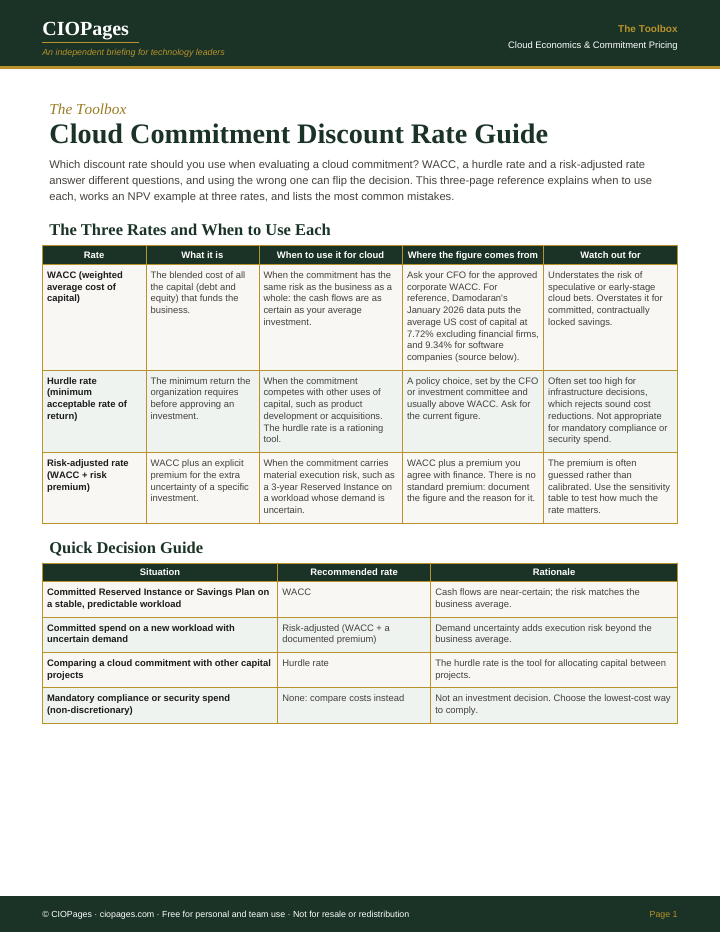
Finance teams use three kinds of rate. The weighted average cost of capital (WACC) blends the cost of the company's debt and equity, and it suits cash flows as risky as the business itself. A hurdle rate is a minimum return set by the CFO or investment committee to ration capital among competing projects. A risk-adjusted rate adds an explicit premium to WACC for a project riskier than average. When the saving is close to the cost of capital, the choice of rate can decide the outcome. Cash flows and the rate must also match: both nominal, including inflation, or both real. Agreeing the rate with finance before the analysis keeps the debate on the cash flows.
What's inside
- A table of the three rates: what each is, when to use it for cloud, where the figure comes from and what to watch for.
- A quick decision guide matching four situations to a rate, from a Reserved Instance on a stable workload to mandatory compliance spend.
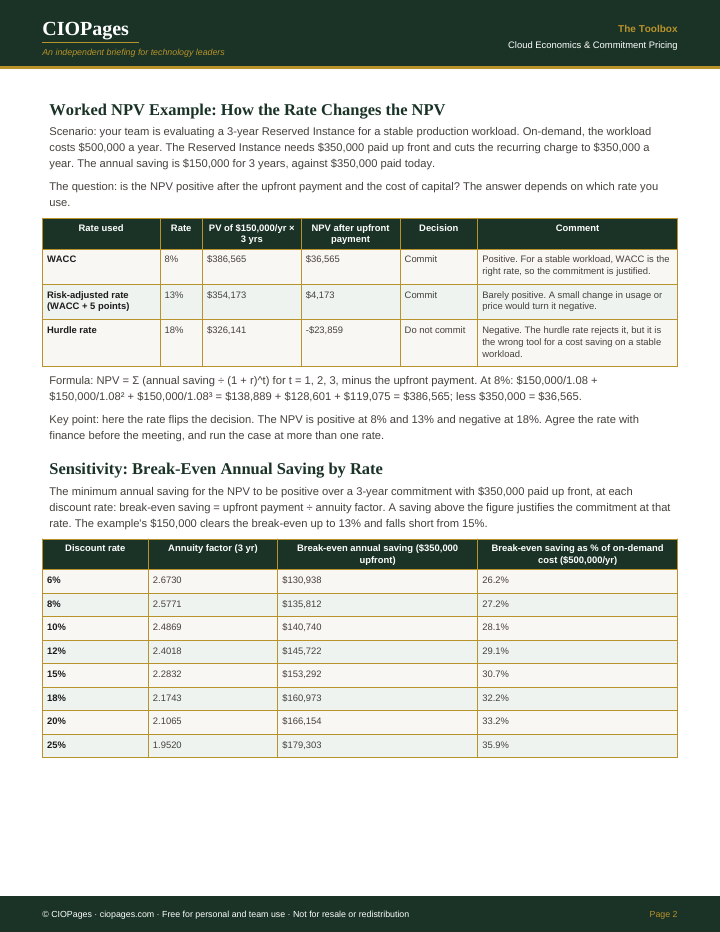
- A worked NPV example for a 3-year Reserved Instance with $350,000 paid up front, calculated at 8%, 13% and 18%, with the formula shown. The NPV is positive at 8% and 13% and negative at 18%.
- A sensitivity table of the break-even annual saving at eight discount rates from 6% to 25%.
- Five common mistakes, including mixing nominal and real rates and treating a vendor's savings figure as the NPV.
Format: PDF (3 pages).
A look inside
Pages 1 and 2 of 3 of the PDF. Select an image to enlarge it.
Who uses it
- Cloud and FinOps leads, to bring a commitment proposal to finance with the rate already agreed.
- Finance business partners, to choose between WACC, a hurdle rate and a risk-adjusted rate for a specific purchase.
- CIOs, to answer an investment committee that applies its hurdle rate to an infrastructure saving.
- Procurement leads, to test a vendor's quoted savings against the organization's actual blended rate.
When to use it
- A 1-year or 3-year Reserved Instance, Savings Plan or committed-use discount is up for purchase.
- An enterprise discount program renewal asks for a larger committed spend.
- Finance rejects a commitment because it falls short of the corporate hurdle rate.
- A commitment is proposed for a new workload whose demand is not yet known.
- Two teams present different NPVs for the same commitment.
How to use it
Bring it to a cloud commitment decision to agree the discount rate with finance before the NPV is argued.
- Classify the decision with the Quick Decision Guide: stable workload, new workload with uncertain demand, competing use of capital, or mandatory compliance spend.
- Ask the CFO for the approved corporate WACC, and the hurdle rate if one applies, rather than estimating them.
- If demand is uncertain, add a risk premium to WACC and write down why. The cheat sheet sets no standard premium: agree it with finance and test it against the sensitivity table.
- Compute the present value of the annual savings with the formula in the worked example, then subtract any upfront payment to get the NPV.
- Compare your annual saving with the break-even figures in the sensitivity table, and run your own case at more than one rate.
- Before the meeting, check the case against the five common mistakes, especially measuring savings against list price instead of your blended rate.
You leave with: An agreed discount rate with its rationale, an NPV for the commitment at that rate, and the break-even saving at which the answer would change.
Where it goes wrong
- Applying the corporate hurdle rate to a cost-avoidance decision, which can reject a near-certain saving.
- Comparing the committed price with on-demand list price instead of the rate already paid after existing discounts.
- Counting the savings and leaving out the upfront payment. The NPV of a commitment is the present value of the savings less the cash paid up front.
- Ignoring the flexibility given up. On-demand pricing keeps the option to scale down or switch, and a commitment has to save enough to cover that.
Get the reference guide
It is free. Enter your work email and we send the download link.
Questions
What discount rate should I use for a Reserved Instance?
For a stable, predictable workload, use the company's WACC, because the savings are about as certain as the business's average cash flows. For a workload with uncertain demand, use WACC plus a documented risk premium. Use the hurdle rate only when the commitment competes with other projects for the same capital.
What is the difference between WACC and a hurdle rate?
WACC is what the company's capital costs, blended across debt and equity. A hurdle rate is a minimum return set by management, usually above WACC, to ration capital among competing projects. WACC is a measured cost; a hurdle rate is a policy choice.
How do you calculate the NPV of a cloud commitment?
Divide each year's saving by (1 + r) raised to the year number, add the results, and subtract the upfront payment. Measure the savings against your actual blended rate, not list price. Over 3 years at 8%, the annuity factor is 2.5771, so each $1 of annual saving is worth about $2.58 today.