
The idea behind it
Vendors pick their own references, and they pick customers who will speak well of them. Those calls still help, but they are not a sample. This script starts with how to reach customers the vendor did not choose: pick names yourself from a customer list in your industry and size, ask for a customer who left and one whose implementation ran late, ask each reference for another name, and use peers, user groups and the integrators on your shortlist.
The call itself is built to get stories rather than ratings. The opening states that nothing will be quoted to the vendor. Twenty questions cover implementation, support, pricing surprises, what the customer would do differently, and renewal, including how easy it would be to leave. A red-flag list covers the signs of a briefed or unrepresentative reference. The notes sheet scores each group from 1 to 5 against what the vendor told you, so calls with different people can be compared on the same terms before the contract is negotiated.
What's inside
- Six ways to reach references the vendor did not choose, including customers who left and the reference's own reference.
- A preparation checklist and an opening script with a confidentiality line.
- Twenty questions in five groups of four: implementation, support, pricing surprises, what they would do differently, and renewal and the relationship.
- Seven red flags to listen for, from a briefed reference to a qualified yes on buying again.
- A closing script, and a notes and scoring sheet that scores each group 1 to 5 against what the vendor told you.
- A filled call for a fictional field service platform evaluation, and a table to compare several calls.
Format: PDF (5 pages) and Word document.
A look inside
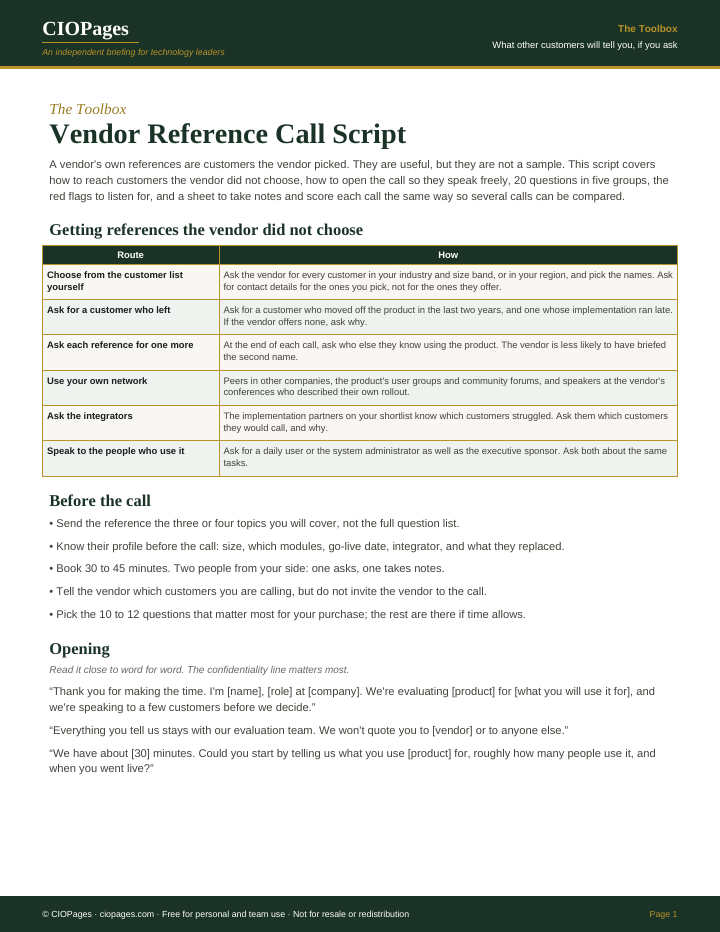
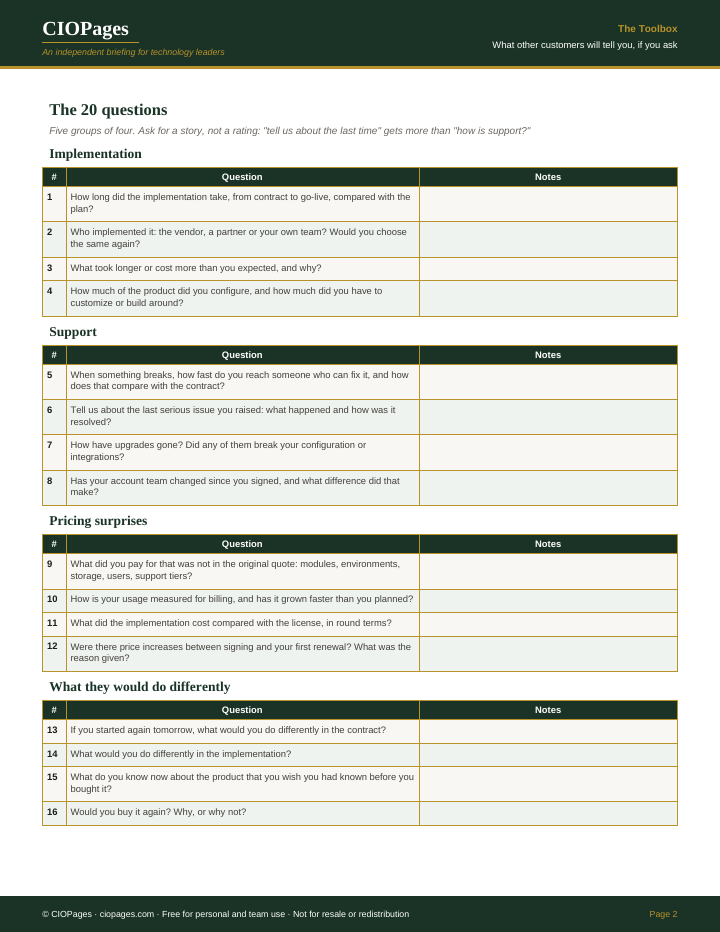
Pages 1 and 2 of 5 of the PDF. Select an image to enlarge it.
Who uses it
- CIOs and IT directors, to check a vendor's claims before signing a multi-year contract.
- Procurement and vendor managers, to run reference checks the same way across a shortlist.
- Program leads, to learn from other customers' implementations before planning their own.
- Enterprise architects, to ask how the product behaved at integration and upgrade.
When to use it
- The shortlist is down to two or three vendors.
- Before the final negotiation, when pricing surprises and contract lessons can still change the terms.
- A vendor's proposal depends on claims about implementation time or support that a demo cannot show.
- At renewal, to compare your experience with other customers'.
How to use it
Run at least one call with a customer the vendor did not choose, use the same sheet for every call, and compare the scores before the final negotiation.
- Get at least one reference the vendor did not choose, using the six routes in the script.
- Prepare: the reference's profile, the 10 to 12 questions that matter most, and two people on the call.
- Open with the script, including the confidentiality line.
- Ask the questions, listening for the red flags and asking for stories.
- Close by asking what you should have asked and who else uses the product.
- Fill in the scoring sheet the same day and compare calls in the comparison table.
You leave with: Scored notes from reference calls, including customers the vendor did not pick, a list of red flags heard, and the follow-up questions for the vendor and the contract.
Where it goes wrong
- Calling only the references the vendor supplied.
- Letting the vendor join or arrange the call.
- Asking for ratings ("how is support?") instead of stories ("tell us about the last serious issue").
- Taking notes in different formats for each call, so they cannot be compared.
Get the script
It is free. Enter your work email and we send the download link.
Questions
How do I get references the vendor did not choose?
Ask for the full customer list in your industry and size band and pick names yourself, ask for a customer who left and one whose implementation ran late, ask each reference who else they know, and use your peer network, user groups and the integrators on your shortlist.
How many reference calls should I make?
Enough to include at least one customer the vendor did not choose and at least one with a deployment like yours. The comparison table has room for five.
What are the warning signs in a reference call?
A reference using the vendor's own phrases, a use case unlike yours, no experience of an upgrade or renewal, workarounds described as normal, silence on cost, a qualified yes on buying again, and the people who chose the product having left.