
The idea behind it
An architecture decision record, or ADR, is a short document that captures one significant design decision: the situation that called for it, the choice made and what follows from it. Michael Nygard proposed the format in a 2011 blog post, Documenting Architecture Decisions. He suggested keeping each record small, numbering them in sequence, and storing them with the code so they are versioned alongside it. His original sections were title, status, context, decision and consequences. Later templates, such as MADR, added the options considered and the people involved.
ADRs solve a specific problem. Design documents and wikis describe what a system looks like, but not why a choice was made over the alternatives. When the people involved move on, the reasons go with them, and later teams either repeat the debate or reverse a decision without knowing the constraint behind it. Records are not edited after acceptance. A decision that changes gets a new ADR, and the old one is marked deprecated or superseded, so the log shows how the architecture got where it is. Recording the conditions for revisiting a decision tells a future reader when the original reasoning no longer applies.
What's inside
- A header: ADR number, title, status, date, and who decided, was consulted and was informed.
- Context: problem statement, drivers and assumptions.
- Options considered: up to three options, each with pros and cons.
- Decision: the decision, the rationale and the conditions for revisiting it.
- Consequences: positive and negative consequences, risks, follow-on decisions and a review date.
- A completed example for a database migration decision.
Format: PDF (4 pages) and Word document.
A look inside
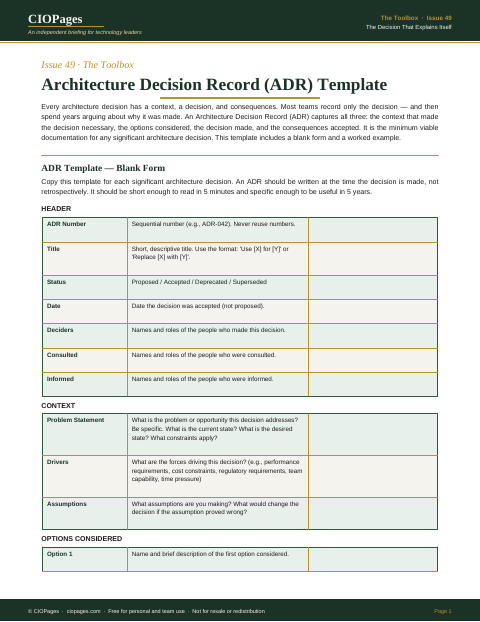
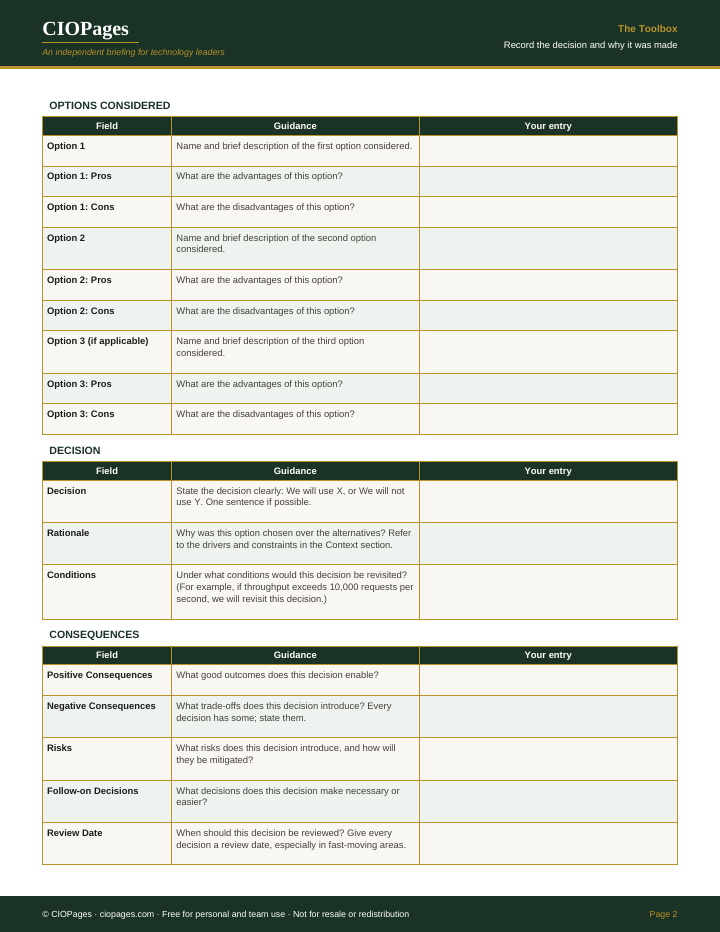
Pages 1 and 2 of 4 of the PDF. Select an image to enlarge it.
Who uses it
- Software and solution architects, to record a decision while the people who made it still remember why.
- Engineering leads, to settle a design debate in writing and give new team members the reasoning behind the system.
- Enterprise architects and architecture review boards, to keep a searchable log of decisions across teams.
- Auditors and security reviewers, to see who decided a change, who was consulted and what risks were accepted.
When to use it
- A team chooses a database, framework, cloud service or integration pattern that will be costly to reverse.
- A component is approaching end of support and a replacement must be picked.
- An architecture review board approves, rejects or conditions a design.
- A team reverses or replaces an earlier decision, which calls for a new ADR that supersedes the old one.
- A debate over the same design question comes back for the second time.
How to use it
Write one when a significant architecture decision is made, and keep it with the code or architecture repository.
- Copy the blank form and fill in the Header: the next sequential ADR number, a title in the form Use X for Y or Replace X with Y, the status, the date accepted, and who decided, was consulted and was informed.
- Write the Context: the problem statement with current state, desired state and constraints, the drivers behind the decision, and the assumptions that would change it if wrong.
- Under Options Considered, describe up to three options with the pros and cons of each.
- State the Decision in one sentence, give the rationale by referring back to the drivers, and set the conditions under which it will be revisited.
- Fill in Consequences: positive and negative consequences, risks and their mitigation, follow-on decisions with their ADR numbers, and a review date.
- Check the length and detail against the ADR-042 worked example, then store the record with the code or in the architecture repository.
You leave with: A numbered record of one decision that a reader can take in within a few minutes: why it was needed, what else was considered, what was chosen, what it costs, and when to look at it again.
Where it goes wrong
- Writing ADRs after the fact, when the context and rejected options have been forgotten. The template asks for the record at the time of the decision.
- Leaving Negative Consequences empty. Every option has a cost, and a record without one reads as advocacy.
- Editing an accepted ADR when the decision changes, instead of writing a new one and marking the old one superseded.
- Listing one real option and two straw men, which hides the trade-off the record is meant to show.
Get the template
It is free. Enter your work email and we send the download link.
Questions
What is an architecture decision record?
An architecture decision record is a short document that captures one significant architecture decision, its context and its consequences. Records are numbered, kept with the code or architecture repository, and not rewritten once accepted. Michael Nygard introduced the format in 2011.
Who should write and own an ADR?
The people making the decision write it, usually the lead engineer or architect closest to the work. The deciders named in the header own it. An architecture team may review ADRs, but the record belongs to the team that has to live with the decision.
When should you write an ADR?
Write one when a decision is significant and hard to reverse: it affects structure, key technologies, interfaces or quality attributes such as security and performance. Write it while the decision is being made. Routine choices that are easy to change do not need one.