
The idea behind it
A board asking about AI wants to know where it is used, whether it is working, what it costs, what could go wrong and whether the company is meeting the law. An AI briefing that leads with adoption figures or a technology roadmap leaves those questions for the discussion, where the answers are improvised. This deck gives one slide to each question and puts the summary and the decisions first, so a director who reads only the first two slides knows the position and what is being asked.
Value is reported against the measure agreed when each use was approved, not against usage, because usage shows spend rather than results. Spend includes AI features in software already licensed as well as model usage, and gives the cost of one completed task for the largest use. The regulation slide sets out dates that have passed and dates still to come. Under the EU AI Act, prohibited practices and the AI literacy obligations have applied since February 2, 2025, and the Act became generally applicable on August 2, 2026, with exceptions. The Digital Omnibus on AI moved the high-risk obligations for Annex III systems to December 2, 2027 and for Annex I products to August 2, 2028. The speaker notes list the questions to prepare for on each slide.
What's inside
- Nine template slides: cover, summary, where AI is used, value delivered against plan, spend, risks and controls, regulation that applies, the people side, and decisions asked of the board.
- A bracketed prompt in every placeholder and table cell.
- Speaker notes on each slide: its purpose, what to say, and three questions to prepare for.
- A filled sample for a fictional company, Northwind Logistics, with sample figures for value, spend and risks.
- A regulation slide with the EU AI Act dates, including the Annex III date moved to December 2, 2027 by the Digital Omnibus on AI, GDPR Article 22 and the NIST AI RMF.
- The PDF guide gives the prompts, the questions and the sample slide by slide.
Format: PDF (7 pages) and PowerPoint file.
A look inside
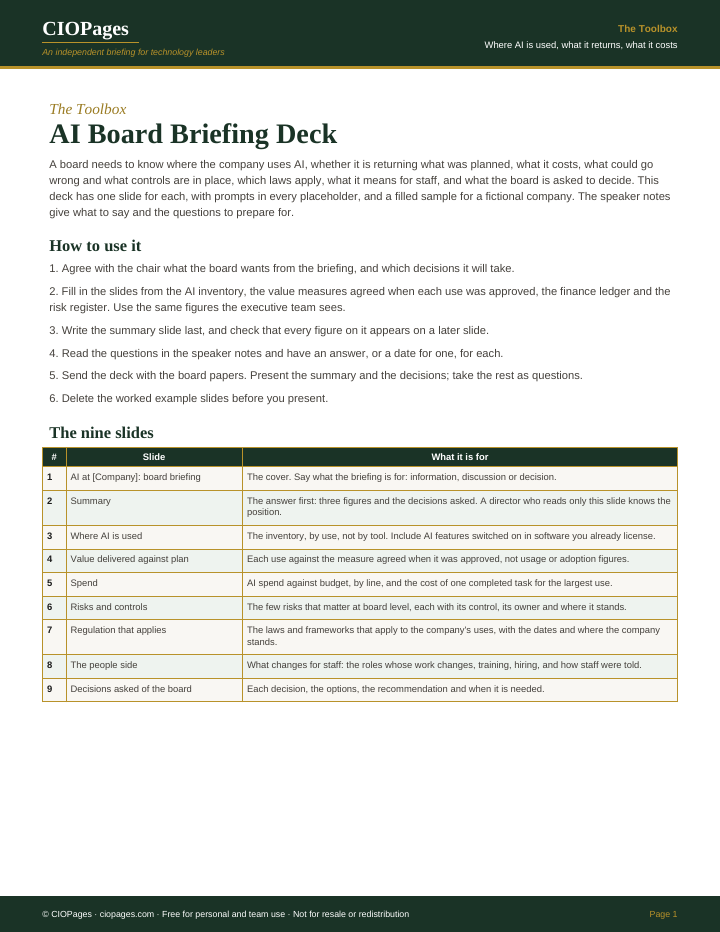
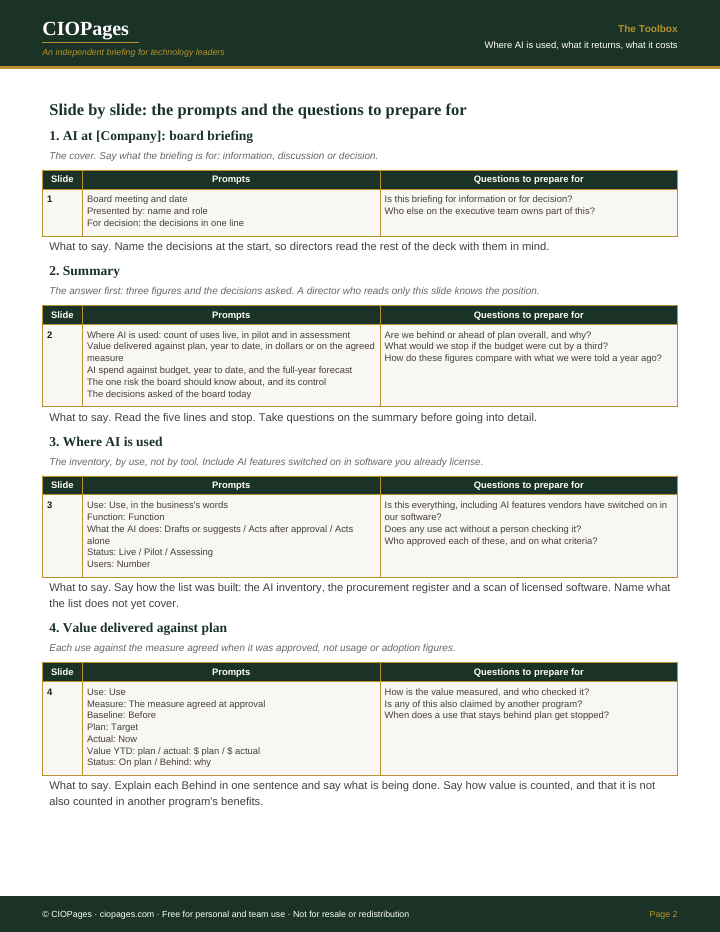
Pages 1 and 2 of 7 of the PDF. Select an image to enlarge it.
Who uses it
- CIOs and chief AI officers, to brief the board on AI and ask for decisions on budget and risk appetite.
- CFOs, to present AI spend and value on the same basis as other investments.
- General counsel and chief risk officers, to set out the regulation and controls that apply.
- Board secretaries and chiefs of staff, to give the board a consistent AI report from one meeting to the next.
When to use it
- The board has asked for an AI plan or an update on AI.
- An AI budget or an AI risk appetite statement needs board approval.
- The audit or risk committee is adding AI to its standing agenda.
- A regulatory date is approaching, such as the Annex III date of December 2, 2027.
How to use it
Build the deck for a board meeting from the AI inventory, the value measures, the finance ledger and the risk register, and delete the sample slides before presenting.
- Agree with the chair what the board wants from the briefing and which decisions it will take.
- Fill in the slides from the AI inventory, the value measures agreed at approval, the finance ledger and the risk register.
- Write the summary slide last, and check that every figure on it appears on a later slide.
- Read the questions in the speaker notes and prepare an answer, or a date for one, for each.
- Delete the worked example slides, send the deck with the board papers, and present the summary and the decisions.
You leave with: A board deck that shows where AI is used, its value against plan, its spend, its risks and controls, the regulation that applies and the effect on staff, with the decisions asked of the board and prepared answers to the likely questions.
Where it goes wrong
- Reporting adoption or usage as value. The value slide asks for the measure agreed when each use was approved.
- Leaving out the AI features vendors have switched on in software the company already licenses.
- Saying a control exists without saying what it is or whether it is live.
- Avoiding the headcount question. The people slide asks for the headcount position stated plainly.
Get the deck
It is free. Enter your work email and we send the download link.
Questions
What should a board AI briefing cover?
Where AI is used, value delivered against plan, spend, the main risks and their controls, the regulation that applies, the effect on staff, and the decisions asked of the board. This deck has one slide for each, with a summary slide first.
Which EU AI Act dates should a board know?
Prohibited practices and AI literacy obligations have applied since February 2, 2025, and general-purpose AI model obligations since August 2, 2025. The Act became applicable on August 2, 2026, with exceptions. Under the Digital Omnibus on AI, high-risk obligations for Annex III systems apply from December 2, 2027, and for Annex I products from August 2, 2028.
How often should the board be briefed on AI?
The deck leaves that to the board as a decision. The Northwind sample recommends a full briefing twice a year, with the value table in each quarterly report.