
The idea behind it
An issue tree breaks one question into smaller questions until each can be answered with a single analysis. A diagnostic tree starts from a problem and asks why: its branches are the possible causes. A solution tree starts from a goal and asks how: its branches are the ways of reaching it. Each level is meant to be mutually exclusive and collectively exhaustive (MECE), so that no cause sits in two branches and none is missing. MECE is the grouping rule associated with Barbara Minto, whose pyramid principle sets out how to group ideas under a single point.
The tree earns its keep at the end branches. Each one carries a hypothesis that could be false, the analysis that would test it, the data it needs and an owner. Work then runs in parallel, and rejected branches are dropped instead of argued over. The worksheet's worked example splits late project delivery by a formula, go-live date = start + work ÷ throughput + waiting, so every delay falls in one of four branches. Three of eight hypotheses are confirmed in the sample, and the solution tree is built only on those three.
What's inside
- Six steps, from writing the key question to pruning branches as results come in.
- Four checks for every level of a tree: no overlap, no gaps, one kind per level, testable at the end.
- Four ways to split a problem that are MECE by construction: a formula, process stages, segments and options.
- A blank diagnostic (why) tree with four branches and eight end branches, and a blank solution (how) tree.
- A hypothesis table: branch, hypothesis, the analysis that would test it, data source, owner, due date and status.
- A worked example on why 7 of a fictional company's last 10 IT projects went live late, split by a delivery-date formula, with eight hypotheses, sample results and the solution tree built on the three confirmed causes.
Format: PDF (6 pages) and PowerPoint file.
A look inside
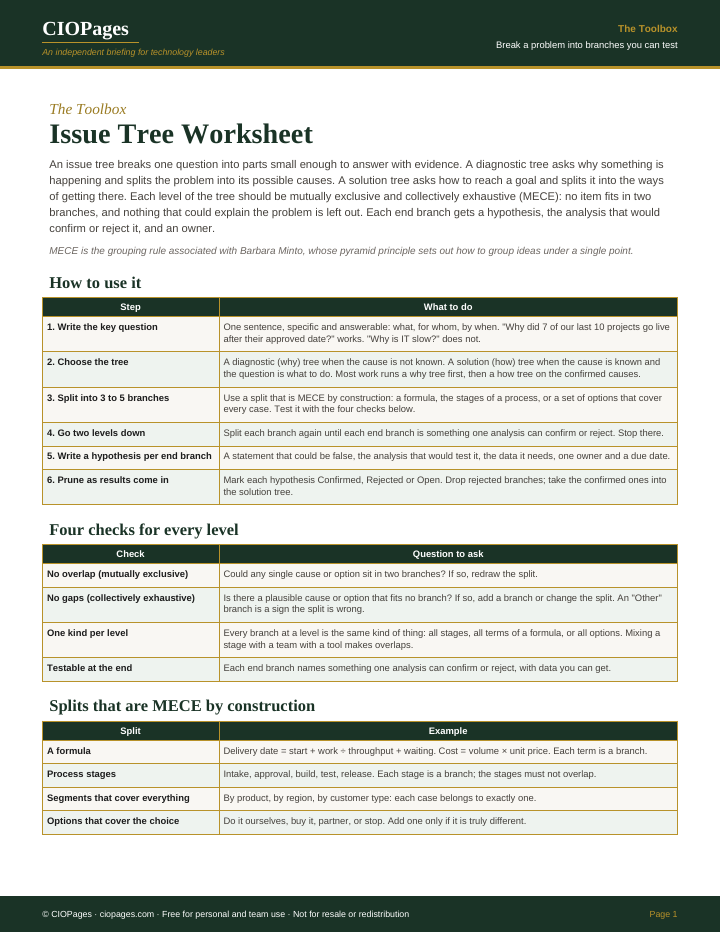
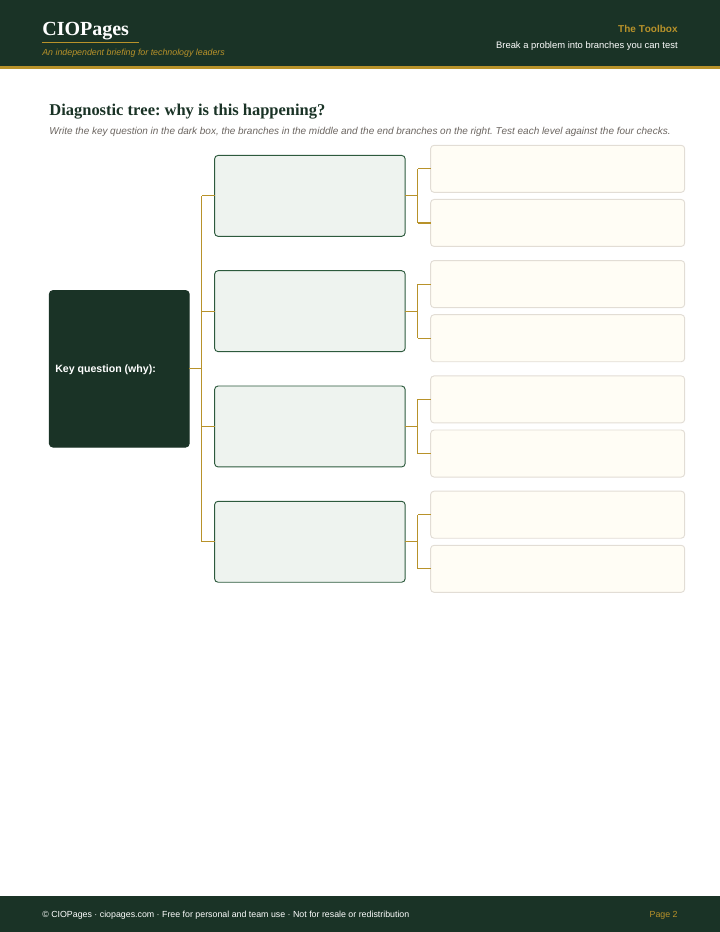
Pages 1 and 2 of 6 of the PDF. Select an image to enlarge it.
Who uses it
- CIOs and IT leaders, to diagnose a recurring problem such as late delivery or rising cost before choosing a fix.
- PMO and portfolio leads, to split a portfolio-wide issue into analyses that named people own.
- Enterprise architects and strategy teams, to structure a recommendation so a reviewer can test each branch.
- Anyone briefing a consultant or vendor, to agree what question is being answered before work starts.
When to use it
- A problem keeps coming back and each fix so far has addressed a symptom.
- A steering committee is debating causes without data.
- A vendor or consultant has proposed a solution and you need to check it addresses the cause.
- A business case needs a structured argument that a board or finance team can test.
How to use it
Draw the why tree with the people who know the problem, assign each hypothesis an owner, then build the how tree on the causes the analysis confirms.
- Write the key question in one specific sentence: what, for whom, by when.
- Choose a why tree if the cause is unknown, or a how tree if the cause is known.
- Split it into three to five branches using a formula, process stages, segments or options, and test the level against the four checks.
- Split each branch again until each end branch can be confirmed or rejected by one analysis.
- Fill in the hypothesis table: hypothesis, analysis, data source, owner and due date for each end branch.
- Mark each hypothesis Confirmed, Rejected or Open as results arrive, and build the how tree on the confirmed causes.
You leave with: A tree of the possible causes or solutions, a hypothesis and an owner for every end branch, and a solution tree tied to the causes the evidence confirmed.
Where it goes wrong
- Splitting by a mix of kinds, such as one branch per team next to one per tool, so the same cause appears twice.
- Adding an "Other" branch, which shows the split leaves something out.
- Writing end branches no analysis can test, such as "culture" with no measure or data source.
- Jumping to the how tree before the why tree has confirmed a cause.
Get the worksheet
It is free. Enter your work email and we send the download link.
Questions
What does MECE mean?
Mutually exclusive, collectively exhaustive. At each level of the tree, no item belongs in two branches, and together the branches cover every possibility. It is the grouping rule associated with Barbara Minto's pyramid principle.
What is the difference between a why tree and a how tree?
A why (diagnostic) tree breaks a problem into its possible causes. A how (solution) tree breaks a goal into the ways of reaching it. A common sequence is a why tree first, then a how tree built on the causes the analysis confirms.
How deep should an issue tree go?
Usually two or three levels. Stop when each end branch is something one analysis can confirm or reject with data you can get. Deeper trees tend to produce analyses nobody has time to run.