
The idea behind it
A SaaS contract sets terms that last longer than the purchase decision. Because the vendor runs the software and holds the data, the buyer's leverage is highest before signing and falls once the service is in use. The clauses that matter most are often not the price. They are the ones that decide what happens later: how much the price can rise at renewal, how much notice is needed to stop an automatic renewal, who owns the data and in what form it comes back, how the uptime promise is measured, and what help the vendor gives on exit.
Many of these terms are negotiable, but only if someone raises them. Vendors publish standard terms written in their own favor, and buyers who accept the order form without a redline get those terms. Data and security clauses also carry legal duties. Under the EU General Data Protection Regulation, a controller must report certain personal data breaches within 72 hours of becoming aware of them, so a vendor's notification window has to be shorter than that. Newer clauses allow vendors to use customer data to train AI models, which raises the same ownership question in a new form. A checklist rated by priority lets a reviewer spend negotiation capital on the clauses that cost the most if missed.
What's inside
- A contract review header: vendor, product, annual value, term, renewal date and reviewer.
- Pricing and renewal: price-increase caps, auto-renewal notice, ratcheting minimums, prepaid fees and overage charges.
- Data ownership and egress: ownership, export format, egress fees, retention after termination and use of your data to train AI models.
- Liability and indemnity: mutual caps, carve-outs, IP indemnity and consequential damages.
- SLA definitions: how uptime is defined, exclusions, service credits and a right to terminate for repeated failure.
- Exit assistance: an exit support period, capped exit fees and documentation of the data schema.
- Security obligations: a named security standard, breach notification, penetration testing and subprocessor terms, with the GDPR Article 28 and 33 rules they rest on.
- Each check explains what to negotiate and has columns for status, the contract clause reference and notes.
Format: PDF (4 pages) and Word document.
A look inside
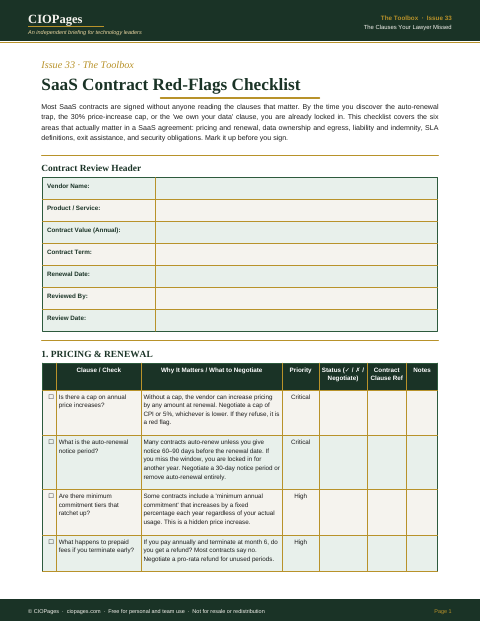
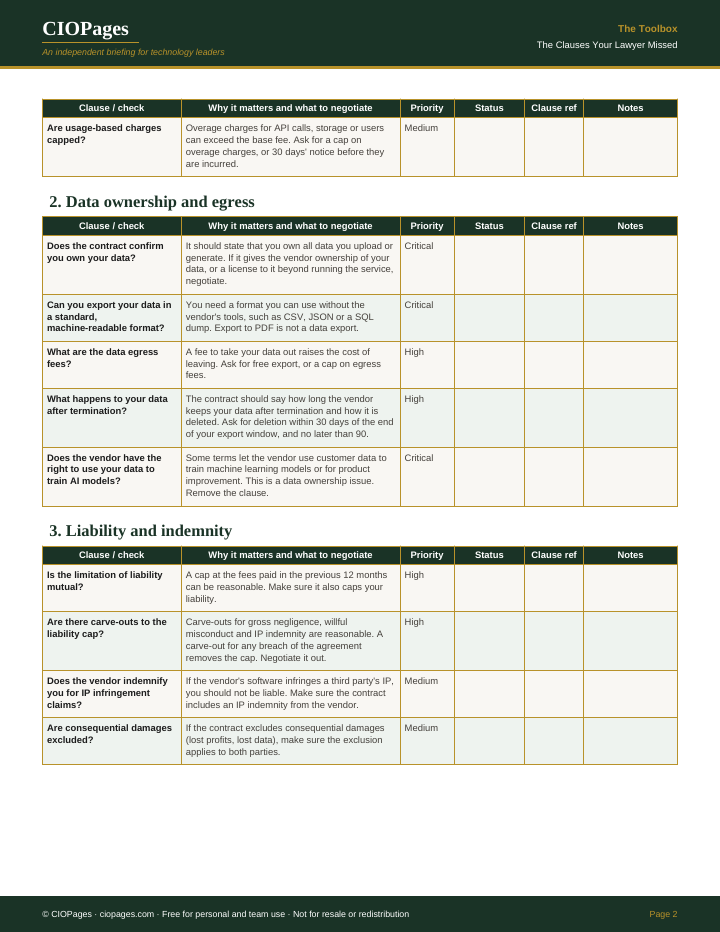
Pages 1 and 2 of 4 of the PDF. Select an image to enlarge it.
Who uses it
- IT procurement and vendor managers, to redline a vendor's standard terms before signature.
- In-house counsel, to check that commercial and technical clauses were reviewed alongside the legal ones.
- CIOs and IT finance leads, to see renewal exposure such as uncapped increases and ratcheting minimums.
- Security and privacy officers, to confirm breach notification, certification and subprocessor terms.
When to use it
- A new SaaS order form and master agreement arrive for signature.
- A renewal date is 90 days or less away and the auto-renewal window may close.
- The vendor announces a price change or a move to new contract terms.
- A vendor updates its terms to allow use of customer data for AI model training.
- The organization plans to leave a SaaS product and needs to know its exit rights.
How to use it
Mark up a SaaS agreement against it before signing or renewing.
- Complete the Contract Review Header with vendor, product, annual value, term, renewal date and reviewer, and put the renewal date in a calendar with the notice window.
- Work through the six areas in order, finding the clause in the contract that answers each check.
- Enter the clause number in the Contract Clause Ref column so the finding can be traced back to the text.
- Mark each check in the Status column as Acceptable, Unacceptable or Negotiate.
- Address every Critical item first: price-increase caps, auto-renewal notice, data ownership, data export format, AI training rights and breach notification.
- Use the Notes column to record the vendor's position and the wording you propose, then bring the open High and Medium items to the same negotiation.
You leave with: A contract marked clause by clause, with each check's status, the clause reference and a list of terms to negotiate in priority order.
Where it goes wrong
- Missing the auto-renewal notice window, which can lock the organization in for another term.
- Accepting "export to PDF" as a data export when a migration needs CSV, JSON or a database dump.
- Accepting a liability cap with a carve-out for any breach of the agreement, which removes the cap.
- Accepting an SLA that defines uptime as the absence of declared incidents rather than a measurable metric.
Get the checklist
It is free. Enter your work email and we send the download link.
Questions
What are the biggest red flags in a SaaS contract?
Uncapped price increases at renewal, long auto-renewal notice periods and clauses that give the vendor ownership of or a license to your data. Others are no right to export data in a standard format and a vendor right to train AI models on your data. Each of these is hard to fix after signing.
What is a reasonable cap on SaaS price increases?
The checklist suggests a cap of CPI or 5%, whichever is lower. Without a cap, the vendor can raise the price by any amount at renewal. A vendor that refuses any cap is a red flag.
Can a SaaS vendor use my data to train AI models?
Only if the contract allows it, and some standard terms do. Read the data use and license sections for any right to use customer data for machine learning or product improvement. The checklist rates this Critical and recommends removing the clause.