
The idea behind it
A stakeholder map lists the people who can help or stop a program and places each on a grid of power and interest. Power is the ability to change the program's scope, money or timing. Interest is how much the program changes that person's work or targets. The grid gives four groups that need different treatment: those with high power and high interest are managed closely, high power and low interest are kept satisfied, low power and high interest are kept informed, and the rest are monitored.
Placement alone does not say what to do. This worksheet adds stance: where each person stands today, from opposed to champion, and the least the program needs from them. The difference is the gap the engagement plan has to close. Each row then records what the person cares about and fears losing, in their own terms, the action, the cadence and channel, one named owner and the next touchpoint. The Excel version calculates the quadrant and the gap and flags touchpoints that are overdue.
What's inside
- Written 1-to-5 scales for power and interest, and a five-step stance scale from opposed to champion.
- The four quadrants with what to do in each: manage closely, keep satisfied, keep informed and monitor.
- A map for up to 30 stakeholders: role, scores, current and needed stance, what they care about, what they fear losing, engagement plan, cadence, channel, owner and next touchpoint.
- An Excel version that calculates the quadrant and the stance gap, flags overdue touchpoints, counts each quadrant and plots the power and interest grid.
- An engagement log for each conversation and the stance observed.
- A worked example: 12 fictional stakeholders for an ERP replacement, with slides of the grid and the plan for those to manage closely.
Format: PDF (6 pages), Excel workbook and PowerPoint file.
A look inside
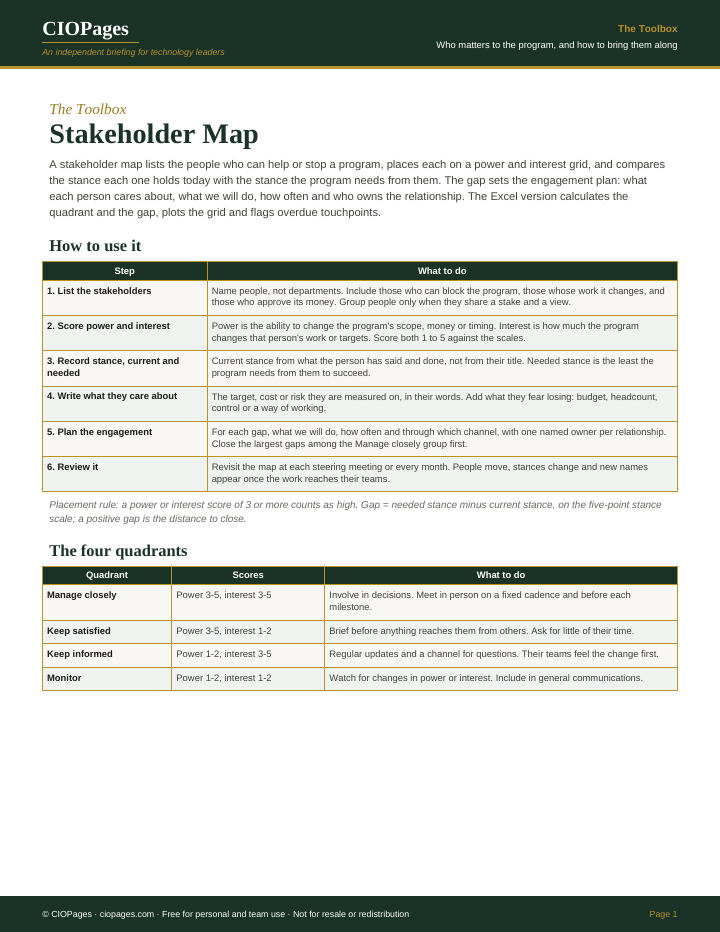
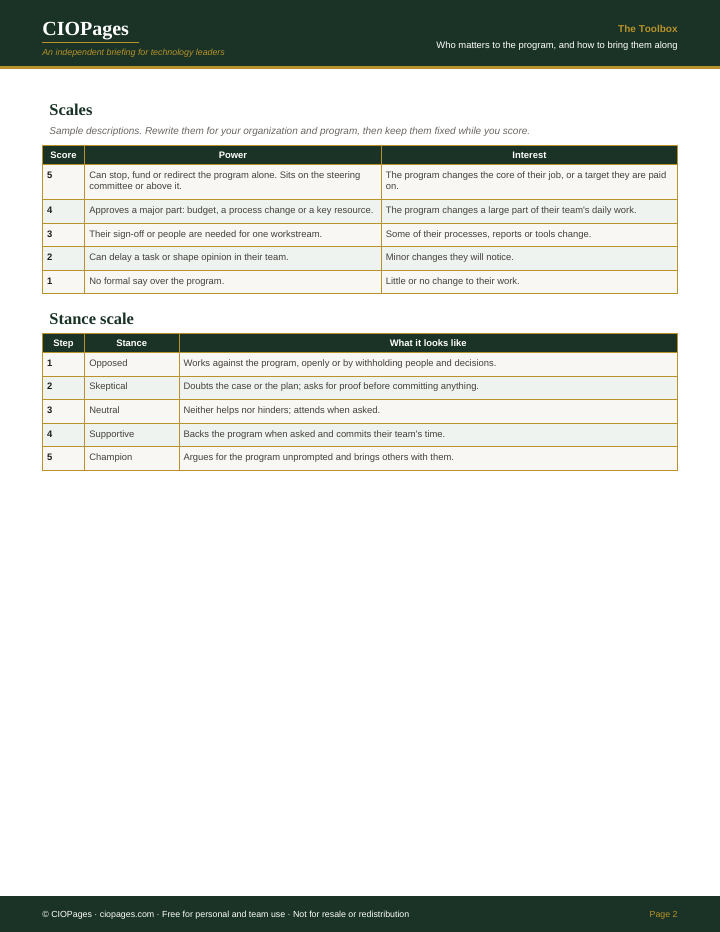
Pages 1 and 2 of 6 of the PDF. Select an image to enlarge it.
Who uses it
- CIOs and program sponsors, to see who can stop a modernization program and who owns each relationship.
- Program directors, to plan engagement alongside the delivery plan and review it at steering meetings.
- Change and adoption leads, to target communication and training at the groups whose work changes most.
- Enterprise architects, to know whose agreement a target-state design needs before it is presented.
When to use it
- An ERP, core system or data platform replacement is being chartered.
- A program has stalled and the reasons are about people, not technology.
- A new sponsor or executive joins partway through a program.
- A cutover or go-live date is approaching and the business units affected need to be ready.
How to use it
Build it at the start of a program, review it at each steering meeting or every month, and work the largest stance gaps among those to manage closely first.
- List the stakeholders by name, including those who can block the program and those whose work it changes.
- Score power and interest 1 to 5 against the scales.
- Record each person's current stance from what they have said and done, and the stance the program needs.
- Write what each cares about and fears losing, in their terms.
- Plan the engagement for each gap: action, cadence, channel, owner and next touchpoint.
- Review the map at each steering meeting, log conversations in the engagement log, and update stances as they change.
You leave with: A power and interest grid of the program's stakeholders, the stance gap for each, and an engagement plan with a named owner and a next date for every relationship.
Where it goes wrong
- Listing departments instead of people, so no one owns the relationship.
- Scoring stance from job titles rather than from what people have said and done.
- Building the map once at kickoff and not revisiting it as the work reaches new teams.
- Writing the same engagement plan for everyone, usually a status email.
Get the worksheet
It is free. Enter your work email and we send the download link.
Questions
What is a power and interest grid?
A two-by-two grid with power on one axis and interest on the other. Stakeholders with high power and high interest are managed closely, high power and low interest kept satisfied, low power and high interest kept informed, and low on both monitored.
How is the stance gap calculated?
Stance is scored on five steps: opposed, skeptical, neutral, supportive and champion. The gap is the needed stance minus the current one. A gap of 2 or more among those to manage closely is where engagement effort goes first.
Should the stakeholder map be shared?
Usually only within the program leadership. It records candid judgments about named people. Share the engagement plan and cadence more widely, not the stance ratings.