
The idea behind it
A blameless post-mortem is a review of an incident that looks for the conditions that allowed it, not the person who made the last mistake. The practice comes from safety-critical fields such as aviation and medicine, where Sidney Dekker's work on just culture argued that blaming individuals hides the system faults that will cause the next failure. John Allspaw described its use in software operations at Etsy in 2012, and Google's Site Reliability Engineering book made it standard practice for SRE teams.
The method rests on one assumption: people acted reasonably given what they knew at the time. If an engineer ran the wrong command, the review asks why the command was easy to run, why nothing stopped it and why no one saw the effect sooner. The 5 Whys, a technique from the Toyota Production System, keeps the group asking until it reaches a process, tooling, knowledge or communication gap. The review is only useful if it changes something. Each finding has to turn into a specific action with an owner, a deadline and a way to tell that the fix worked. A review that ends with "be more careful" has produced no action, because care cannot be assigned or tested.
What's inside
- An incident header: ID, severity, start and end times, duration, services affected, user impact, facilitator and participants.
- An incident timeline table: time, event and actor or system.
- A contributing factors table with a 5 Whys column and a category for each factor.
- A fishbone diagram with six cause categories and a question to ask for each.
- Three questions on what made the incident hard to detect and recover from, and what went well.
- An action items table with owner, due date, success criterion and a Done? box.
- A worked example for a payment API incident.
- A facilitation guide with a timed agenda, from the opening to the action items.
Format: PDF (7 pages) and Word document.
A look inside
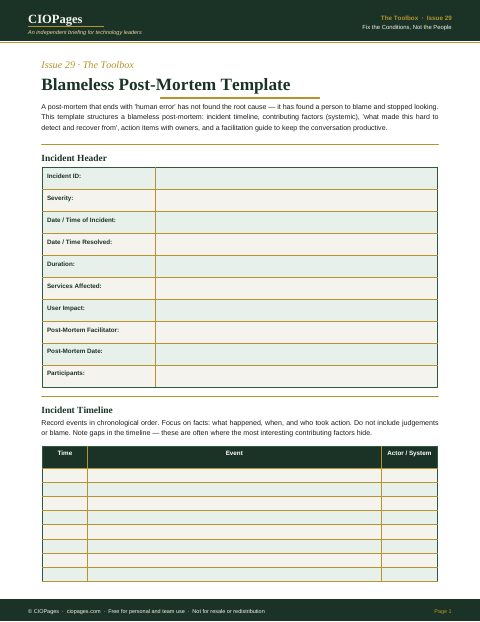
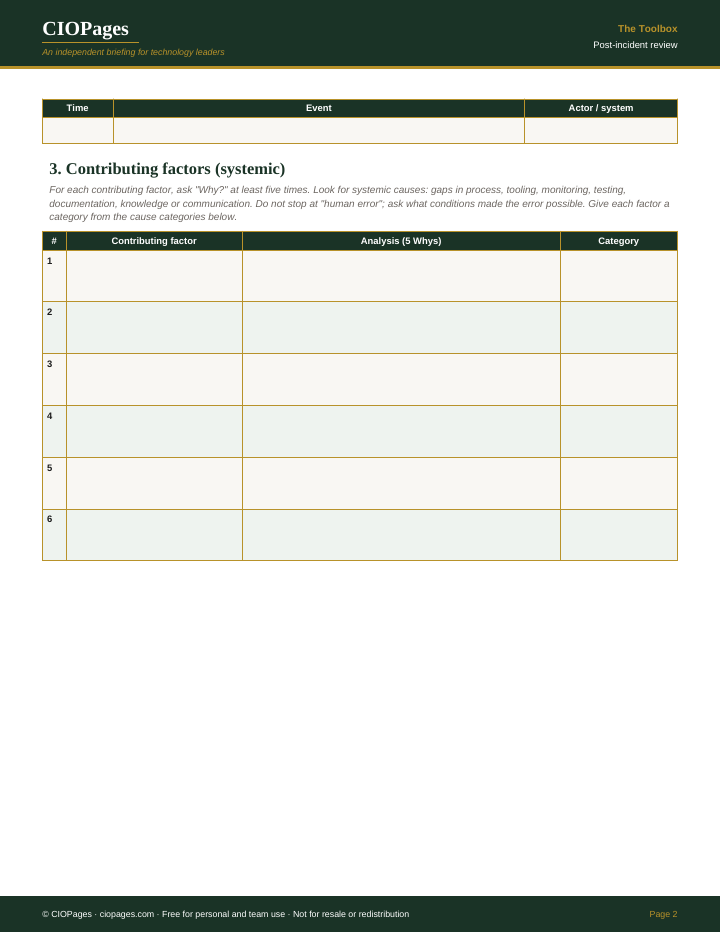
Pages 1 and 2 of 7 of the PDF. Select an image to enlarge it.
Who uses it
- Incident commanders and SRE leads, to run the review meeting to a fixed agenda and finish with owned actions.
- Engineering managers, to track action items from several incidents to closure and spot repeated contributing factors.
- On-call engineers, to reconstruct the timeline while logs and chat history are still fresh.
- CIOs and heads of operations, to see the systemic causes behind outages without a hunt for whoever was on shift.
When to use it
- A SEV-1 or SEV-2 incident has just been resolved and the review needs to happen within the week.
- An incident report names "human error" as the root cause and stops there.
- The same kind of outage has happened twice and the first review's actions were never finished.
- A near miss was caught by luck rather than by monitoring.
- A team is adopting SRE practices and has no shared format for incident reviews.
How to use it
Hold the review within 5 business days of the incident and give every action item an owner, a date and a success criterion.
- Fill in the Incident Header within a day of resolution: severity, start and end times, duration, services affected and user impact.
- Draft the Incident Timeline from alerts, chat logs and deploy records, recording only what happened, when and which person or system acted, and send it to participants 24 hours before the meeting.
- Open the meeting by restating the blameless principle, then walk the timeline for 15 minutes and mark any gaps.
- In the Contributing Factors table, ask "Why?" at least five times per factor and give each one a category such as process, monitoring, documentation or testing.
- Answer the three questions on what made the incident hard to detect and recover from, and what went well.
- Write 3 to 5 action items, each with a named owner, a due date and a success criterion that can be checked, and name someone other than the owners to track them to closure.
- Agree before closing who receives the summary: the team, wider engineering or customers.
You leave with: A written record of the incident with a factual timeline, the systemic causes behind it and a short list of owned, dated fixes, each with a test that shows when it is done.
Where it goes wrong
- Stopping at "human error" instead of asking what conditions made the error possible.
- Writing judgments into the timeline, such as "the engineer was slow to respond", instead of times and events.
- Producing a long list of action items with no owners or no success criteria, so none of them close.
- Holding the review weeks later, when the people involved no longer remember what they saw.
Get the template
It is free. Enter your work email and we send the download link.
Questions
What does blameless mean in a post-mortem?
It means the review assumes everyone acted reasonably with the information they had, and looks for the system conditions behind the failure. People can then describe their actions honestly without fear of punishment. It does not mean no one is accountable: action items still have named owners.
How soon after an incident should a post-mortem be held?
The template's facilitation guide sets a limit of 5 business days. After that, memories fade and logs may roll over. Share a draft timeline a day before the meeting so participants can correct it.
What is the difference between a root cause and a contributing factor?
A root cause suggests one thing went wrong. Most incidents in complex systems have several contributing factors, such as a missing alert, an outdated runbook and an untested failure mode, that together allowed the failure. Recording each factor separately gives each its own fix.