
The idea behind it
The template follows Barbara Minto's pyramid principle. Minto developed it at McKinsey & Company and set it out in The Pyramid Principle, written in 1987 and superseded by her 1996 textbook, The Minto Pyramid Principle. Her site describes the idea as thinking organized as a pyramid under a single point, with the writer guiding the reader down it. In a board memo, the single point is the recommendation, and the points beneath it answer the question it raises in a director's mind, usually why.
The memo opens with the ask, the decision wanted, with the amount and the date, then the recommendation in two sentences. Three supporting points follow, each a claim with its evidence. Options considered, risks with owners, cost and timing, and what happens if the board does nothing come next, so a director can test the recommendation without asking for them. Detail goes in named appendices. The sample shows a fictional company asking for approval of an AI agent-assist rollout, with every figure labeled a sample assumption.
What's inside
- An explanation of the structure, from Barbara Minto's pyramid principle, and four rules for applying it on the page.
- The template: header, the ask, recommendation, three supporting points with evidence, options considered, risks, cost and timing, if we do nothing, and appendices, each with guidance and a length budget.
- A blank one-page memo to write in.
- A filled sample: a fictional company asking its board to approve an AI agent-assist rollout for customer service, with sample figures.
- A 13-point checklist for editing the memo down to one page.
- Sources for the pyramid principle.
Format: PDF (4 pages) and Word document.
A look inside
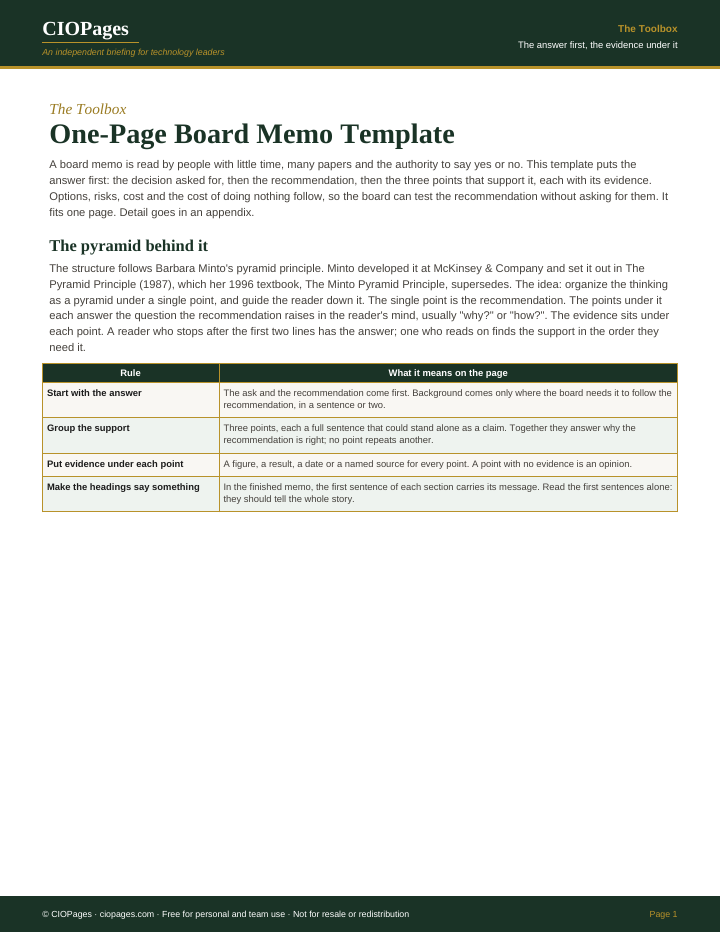
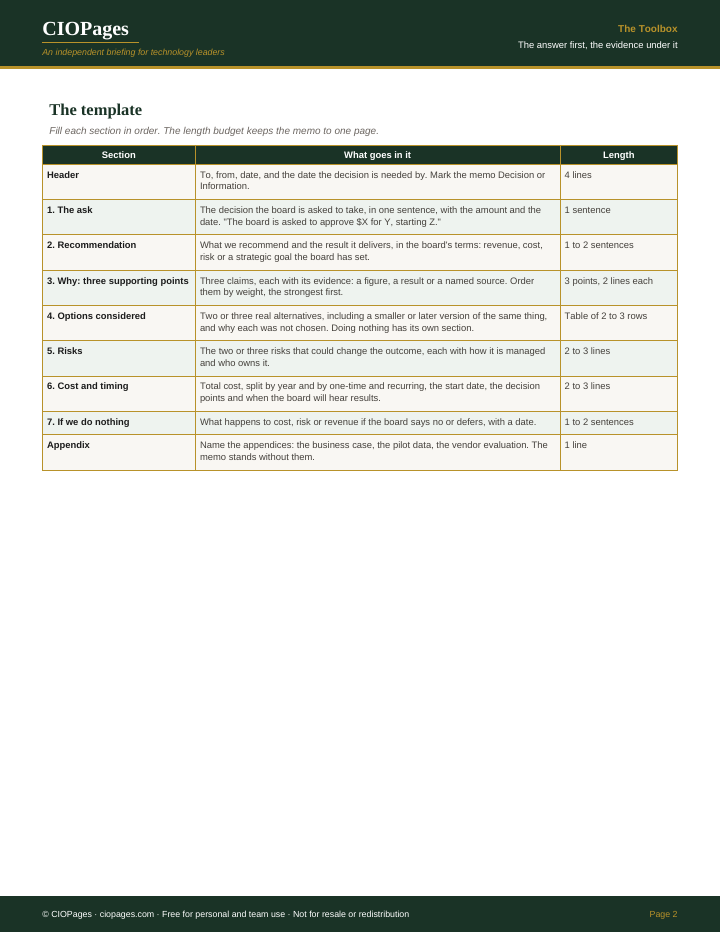
Pages 1 and 2 of 4 of the PDF. Select an image to enlarge it.
Who uses it
- CIOs and CTOs, to take a technology or AI investment to the board or its audit or risk committee.
- Chiefs of staff and strategy leads, to edit papers for the board pack.
- Program sponsors, to ask an executive committee for a go or no-go decision.
- Heads of AI and data, to put a use-case investment to the people who fund it.
When to use it
- A funding or approval decision needs a paper in the board pack.
- An AI use case is moving from pilot to production and needs a budget decision.
- A long slide deck needs to be reduced to the decision and its support.
- A board has asked for a recommendation on a risk, such as an end-of-support system.
How to use it
Write the memo in section order with the length budgets, then run the checklist before it goes in the board pack.
- Write the ask in one sentence: the decision, the amount and the date.
- Write the recommendation and the result it delivers in the board's terms.
- Write three supporting points, each a full sentence with a figure, result or named source.
- Add two or three real options, including a smaller or later version, and why each was not chosen.
- Add the main risks with owners, the cost by year and the timing, and what happens if nothing is done.
- Run the 13-point checklist and move detail to appendices until the memo fits one page.
You leave with: A one-page memo that states the decision wanted first, supports it with three evidenced points, and answers the board's questions on options, risk, cost and inaction.
Where it goes wrong
- Opening with background and history, so the ask appears at the bottom.
- Supporting points that are adjectives rather than figures.
- Options that are straw men, with no smaller or later version of the same thing.
- Fitting the page by shrinking the font instead of cutting text.
Get the template
It is free. Enter your work email and we send the download link.
Questions
What is the pyramid principle?
Barbara Minto's method for structuring business writing. Her site describes thinking organized as a pyramid under a single point, with the reader guided down it. The main point comes first, and the ideas beneath it support it in groups. She set it out in The Pyramid Principle (1987), superseded by the 1996 textbook The Minto Pyramid Principle.
Why put the recommendation first?
Directors read many papers. With the ask and the recommendation in the first lines, a reader who stops early still knows what is being asked and what you recommend. The rest of the memo supports and tests it.
What goes in the appendix?
The business case, pilot data, vendor evaluation and any detailed financials. The memo names them, and it must stand without them.